By Brittany Vonow
16th November 2017, 11:39 am
Updated: 16th November 2017, 12:39 pm
‘IT MAKES THE SICK SICKER’ Mum claims ‘Wi-Fi allergy’ drove her daughter to suicide as she appeals for it be banned from schools and hospitals
Debbie Fry’s daughter Jenny was found dead in woodlands near her Cotswolds home when she was just 15
A MUM who claimed her teen daughter took her own life after being in constant misery due to a Wi-Fi allergy is fighting for wireless internet to be removed from every school.
Debbie Fry said her 15-year-old daughter Jenny suffered from tiredness, headaches and bladder problems every time she was near a wireless router.
Jenny took her own life when she was just 15
The teen was found dead in woodlands near her home in the Cotswolds, Oxfordshire, in 2015, with the coroner recording a narrative verdict on her cause of death, as there was no medical proof Jenny suffered from Electromagnetic Hypersensitivity Syndrome (EHS).
But Debbie is now on a mission to have Wi-Fi removed from all schools and hospitals – saying Government plans to introduce internet across the NHS were disastrous.
She told Gloucestershire Live: “They are planning to put in something that makes the sick, sicker.
“There’s some urgency to which the whole of the UK’s population needs to be told this technology is not as safe as we are led to believe.”
The teen’s mother is now campaigning to have Wi-Fi taken out of schools and hospitals
The teen’s mother is now campaigning to have Wi-Fi taken out of schools and hospitals
Mrs Fry, who will now be one of the speakers to address a public health talk in Stroud over the weekend, had previously told the inquest into her daughter’s death that Jenny had suffered from a mystery illness for three years before her death.
She said: “Jenny was getting ill and so was I. I did some research and found how dangerous Wi-Fi could be so I had it taken out of the house.
“Both Jenny and I were fine at home but Jenny continued to be ill at school in certain areas.”
She vowed to keep fighting against having Wi-Fi in nurseries and schools, urging the government to research EHS.
What is electromagnetic hypersensitivy?
Ashland, MA — (SBWIRE) — 09/28/2015 — Based on its own review of the matter, the Ashland Public School District is reducing wireless radiation exposures to children by instituting district wide “best practices for mobile devices”. Spurred by parent Cecelia Doucette’s concerns about the lack of safety data on Wi-Fi and children, the district investigated the issue and developed a policy to substantially reduce wireless exposures to stud
US Public School Limits Wi-Fi
ents and staff. Doucette not only brought the issue to the district’s attention, but then also worked with state legislatures who introduced two bills concerning electromagnetic radiation this session. The Environmental Health Trust submitted written testimony on MA Senate Bill 1222 after expert scientists presented information on wireless health risks at a briefing at the Massachusetts State House in June 2015.
Since wireless devices are constantly emitting radiation even when the user is not using the Internet, the instruction to “turn it off when not in use ” stops the Wi-Fi antennas from continuously emitting radiation and is one simple way to reduce the radiation dose and exposure time for children and staff.
Instructions for “Best Practices” are posted in every classroom and include:
– Turn off the device when not in use
– Turn Wi-Fi on only when needed
– Always place the mobile device on a solid surface
– Viewing distance should be a minimum of 12 inches from the screen
– Specific product information guides are available through the IT department
– We ask that staff members regularly remind and instruct students in using best practices in regards to mobile devices
Ashland’s Best Practice of “keeping the device on a table” and no closer than a 12 inch viewing distance is critically important. Laptops and tablets have fine print warnings buried in their manuals specifically stating that the laptop should be at least 8 inches away from the user so that the user is not exposed to radiation levels that exceed as-tested FCC levels. If a device is used on a lap, as is common practice, the student could receive radiation levels far exceeding FCC limits. FCC limits are set to prevent the radiation from heating the brain and body but are not set to avoid chronic impacts on the developing nervous system or reproductive organs.
Many are unaware of FCC fine print advisories in the manuals of every wireless device confirming as-tested distances set to avoid heating. Cell phones, laptops and even baby monitors have these specific instructions in their product information guides. By referring to the product information guides, Ashland Public Schools are informing people about the need to keep a distance between the device and our bodies. As a public service, Environmental Health Trust (EHT) has compiled these fine print warnings on their website Showthefineprint.org.
It is important to note that even if users comply with these FCC recommended distances as stated in the device manual, accumulating research shows that biological damage can occur from wireless radiation levels far lower than these FCC levels. FCC limits are only set to protect people from heating harm and do not address non-thermal effects.
This ground breaking policy action by the Massachusetts school district is indicative of the wave of parents raising concerns about Wi-Fi across the country. Ashland, Massachusetts parent Cecelia Doucette wrote an article in Ashland Local Town Pages about these new best practices. Significant news and print media have picked the issue up after Massachusetts parents filed a lawsuit against a private boarding school alleging the school did not accommodate their 12-year-old child’s diagnosed debilitating sensitivity to the school’s WiFi system.
Ashland is the first US public school to create such policy on wireless transmitting devices. However, this US Massachusetts school district now joins dozens of schools and governments that have already implemented even more stringent measures to reduce wireless exposure to children. For example, Israel and France have banned Wi-Fi in kindergarten. The European Union recommends wired Internet rather than wireless in schools.
“Right To Know” efforts by local governments are also moving across the United States. A judge just upheld Berkeley’s new Cell Phone Right To Know Ordinance which requires cell phone sellers to tell customers about these FCC radio frequency radiation distances.
Suffolk County in New York voted to label wireless routers in all public buildings including schools. The US United Federation of Teachers Union now hosts a webpage on how to reduce exposures to protect pregnant women, other staff members and students.
The Environmental Health Trust maintains a regularly updated database of these worldwide precautionary policies on wireless related to children and schools.
About Environmental Health Trust
Environmental Health Trust (EHT) educates individuals, health professionals and communities about controllable environmental health risks and policy changes needed to reduce those risks. Currently EHT is raising health concerns about wireless in schools and recommending safer hardwired internet connection installations. The foundation’s website is the go-to place for clear, science-based information to prevent disease.
Wi-Fi health advocate Cecilia Doucette and parent Keith Marciniak have created a five-part YouTube series that describes the health hazards of pulsed electro-magnetic radiation that floods the environment.
The series covers radiation sources such as cellphones, computers, iPads, cordless phones, cell towers, and Wi-Fi routers that are in most classrooms in the U.S.
Episodes are “Discovering the Dangers”; “Educating the Greater Community”; “Why We Don’t Know”; “Impacts of Excessive Screen Time,” and “Solutions.”
BULLETIN: Apple now recommends using a headset when talking to the iPhone Activate the hands-free option. It tells users to carry the iPhone at least 5 mm [one-fifth of an inch] away from the body. Says Apple: “This ensures that the load is not above the values determined in the tests. Enclosures with metal parts [i..e., cars, buses, trains, planes] may alter the RF (high-frequency) performance of the equipment and adversely affect its compliance with the RF power guidelines in a manner that has not been tested or certified.”
Apple is reacting to measurements that show its two latest products, the iPhone 7 and the iPhone 7 plus, have a significantly higher radiation load than older models. Both products are at the so-called SAR value (specific absorption rate) at up to 1.38.
Below are some of the scientific papers cited in the Doucette/Marciniak series.
Harvard Law School Center for Ethics’ Report, Captured Agency: How the Federal Communications Commission is Dominated by the Industries it Presumably Regulates: http://ethics.harvard.edu/files/cente…
International Appeal: Scientists Call for Protection from Non-ionizing Electromagnetic Field Exposure, signed by 221 world scientists specializing in electromagnetic fields (EMFs) and submitted to the World Health Organization and the United Nations: https://www.emfscientist.org/images/d…
Columbia University’s Dr. Martin Blank gives a three-minute appeal overview here: https://vimeo.com/123468632
IEEE Power Electronics Magazine article indicating even the IEEE, which helped to set the FCC standards in 1996 based on thermal effects, now recognizes biological effects at the non-thermal level: Some Effects of Weak Magnetic Fields on Biological Systems: RF fields can change radical concentrations and cancer growth rates: http://www.wirelesseducation.org/ieee…
Dr. Martin Pall’s 16-minute lecture on what electromagnetic radiation is doing to our bodies and why it is causing illness:https://www.youtube.com/watch?v=3kQQy…
Nobel Peace Prize Co-Laureate Scientist Dr. Devra Davis and former long-time Microsoft Canada President Frank Clegg presenting the need for an EMF right-to-know initiative to the MA legislature: https://vimeo.com/134411701
Environmental Health Trust article, First US Public School District Limits Wi-Fi Radiation Exposure to Students and Staff: http://ehtrust.org/first-us-public-sc…
WACA-TV public service video for the Acoustimeter on loan at Ashland Public Library showing how to measure common home exposures and solutions to create a safer environment: https://vimeo.com/159873631
PINETOP-LAKESIDE — The Pinetop-Lakeside Board of Adjustment rejected an application Nov. 2 for a variance request by Verizon Wireless to build 94-foot tower on the corner of Woodland Lake Road and Julia Lane.
The site is located on the former Pico’s Nursery property, which is now operated as an wedding and event center.
Town Community Development Director Cody Blake offered introductory comments and said that Verizon’s interest in building a new tower was a “complaint-driven” response from local residents requests. The Board of Adjustment, at their Oct. 19, meeting also requested that the town assess the possibility of co-locating on a tower owned by White Mountain Communications. Verizon said the existing tower would not satisfy their needs, Blake said.
Fifteen residents lined up following Blake’s introductory comments to speak on the issue themselves. An overwhelming theme of most who testified Nov. 2 said they were mostly concerned with possible negative health effects, and property values dropping should the tower become a reality. Most said they didn’t want the tower in their residential neighborhood.
Although most everyone agreed that the wireless service is poor in the area, most said they didn’t want better service if it meant a potential risk to their health or a drop they would see in property values.
The first four speakers mentioned their health concerns for two autistic children who live within about 100 feet of the proposed location.
Don McMasters, who also lives near the proposed tower site, introduced himself as the president of the White Mountains Autism Foundation and said that living near a cell tower is extremely damaging to an autistic person. he also spoke to the general feeling against having the tower in a residential area.
“Everyone who would like to live within 400 feet of a cell tower, raise your hands,” he said. Very few hands went up.
“We have a son with autism who is 29 and we’ve been told not to live anywhere near high EMF (Electromagnetic fields).” Barb McMasters, Bob’s wife said.
McMasters gave members of the board an 18-page packet of materials about the health risks involving cell towers.
“Some say it’s a theory. Let me tell you, it’s not a theory, it’s real. Please dig into it. And by the way, there are six — and not two — individuals with autism living in this community,” he added
Chris Paxman, the father of two autistic children who lives across the street from the proposed tower site gave the most emotional presentation of the night.
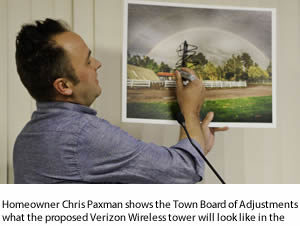
Paxman is a photographer, came to the lectern fighting back tears. He said his children were the two that everyone was talking about and that he would have a view of the new tower from his front window. Paxman produced photographs of his view of the Pico Greenhouse property with a rainbow, a photo of one son and an aerial view he took with a drone to show the board and the crowd what he was faced with.
“Let’s make this more realistic,” Paxman said as he took out a dark felt pen and drew the tower onto his photograph. “Oh, and let’s put those realistic branches they propose on it, too,” he said, referring to plans to make the tower look like an tree.
As he drew a rough-looking tower sketch on his photo, the impact of Paxman’s emotions seemed to grip the audience. He then produced a photo of one of his son said, “He can’t go anywhere, but he has the time of his life in the backyard. I am not really willing to risk myself or my kids for this.”
Merry Lee Cox, who lives nearby, has been a vocal opponent of the tower. She said it was a lack of communication about the tower that brought her to the meeting Oct. 19. She spoke of a possible 5 -20 percent drop in nearby property values as a result of the tower.
“We’re middle-class people and our homes are our equity,” she said, adding that tower fires can occur, causing catastrophic failure and referencing YouTube videos to confirm such incidents.
The property owners, Alison Stewart and John Samora, were the only ones to speak in favor of the tower. They said they couldn’t testify to the health concerns, but said it is a commercial property and they were going to try to make it blend in. They said they planned to make the facility as aesthetically pleasing to the neighborhood as possible by planting trees and shrubs to blend it into the trees. Stewart and Samora own the Greenhouse on Woodland, a wedding and event center located at the former Pico’s Nursery location.
In written comments the offered after the meeting, Samora said that he found some of the passionate comments made by people at the meeting “hypocritical.”
“I am willing to bet that most if not all of those speakers at the (town) council meeting…had cell phones in their pockets, which also emit waves. Further, there was a lot of talk about protecting our children from these waves, and yet, many of these same people send their children to the Blue Ridge School district where there are not one, but two cell towers on their campuses,” he wrote.
“You know EM radiation is everywhere. I mean, it’s just floating all around us these days,” Councilman James Snitzer said. “We used to be told that watching TV would give us radiation, then it was microwave ovens and now it’s cell phones and they’re everywhere, so they wouldn’t be around in my opinion, if that was true. I just don’t believe there’s a significant risk from cell phones.”{/div}
Councilor Kathy Dahnk said she would like to see Verizon research an area outside of a residential area. Others wondered why a Verizon representative was not there to answer questions.
Councilor Carla Bowen said she just didn’t think it was the right place. Then Dahnk made a motion to deny the variance, which was seconded by Bowen. The vote passed 6-1 to deny Verizon’s variance request, with Snitzer against the denial and Councilor Norris Dodd attending via teleconference.
Samora and Stewart spoke greeted many in the crowd following the meeting, and hugged Chris Paxman. Samora said he hoped the tower issue would not affect his relationships with all of his neighbors.
”With a few, certainly. But not, I hope, with most…we were looking at this as partially a public safety issue and an infrastructure issue as proposed,” he wrote.
If petitions are any indication, a growing number of Canadians are very concerned about being zapped by radiation from their cellphones, baby monitors and wireless internet routers.
Seven of the 16 environmental petitions submitted to the auditor general’s office between July 2016 and June 2017 “concerned potential adverse health effects on humans from radiofrequency electromagnetic radiation from personal wireless devices,” according to one of the fall reports from Canada’s environment commissioner, released Tuesday. That’s up from one in 2014-2015 and none in 2015-2016.
Several of the petitions express concern about how close people hold their cellphones to their bodies. One requests that Canada stop marketing wireless devices to children under 14. Another focuses on the possible impacts of radiation on the human eye and newborn babies. One asks that Statistics Canada collect data on electromagnetic hypersensitivity as part of its Canadian community health survey, while another wants the federal government to monitor radiofrequency and microwave radiation in schools.
The petitions were submitted by individuals and organizations in Ontario and Manitoba. One was filed by a group called Canadians for Safe Technology (C4ST), which claims on its website that “current assumptions about the safety of electromagnetic radiation are outdated and must be revised.”
On its website, Health Canada states that a growing number of people are reporting symptoms they attribute to electromagnetic fields (EMFs), including headaches, fatigue, nausea and skin redness. But according to the department, “there is no scientific evidence that the symptoms attributed to EHS (electromagnetic hypersensitivity) are actually caused by exposure to EMFs.”
According to the World Health Organization’s website, ‘no adverse health effects from low level, long-exposure to radiofrequency or power frequency fields have been confirmed.’
The true cause of the symptoms is “unclear,” Health Canada says, but could be related to fluorescent lights or glare from computer monitors.
The petitioners all take aim at Canada’s Safety Code 6, Health Canada’s radiofrequency human exposure guidelines, many suggesting the guidelines aren’t stringent enough.
Health Canada says Safety Code 6 guidelines are based on hundreds of peer-reviewed studies and are “set far below the lowest level of RF (radiofrequency) exposure that could produce potentially harmful effects in humans.” The code was most recently updated in 2015.
According to the World Health Organization’s website, “no adverse health effects from low level, long-exposure to radiofrequency or power frequency fields have been confirmed,” though research continues. Studies to date have not shown a link between normal exposure to radiofrequency radiation and increased risk of cataracts, cancer or pregnancy problems.
In June 2015, the House of Commons health committee issued a report recommending that the government further study electromagnetic hypersensitivity and a possible connection between wireless device use and cancer. In response, the government promised to keep studying the international scientific literature.
But that’s not good enough, argue the petitioners. According to the environment commissioner’s report, one petition “asks the (health) minister to produce the scientific findings that Health Canada used to support Safety Code 6.”
Unlike other government petitions, environmental petitions don’t need multiple signatures. They are submitted to the environment commissioner, who obtains answers from relevant federal ministers. None of these seven petitions have yet received a response.
In contrast, public petitions presented in the House of Commons require the support of at least five Canadians and must be sponsored by a member of Parliament.
Recent public petitions include requests that the government ban shock collars on pets (5,421 signatures), that curling be declared a national sport (3,659 signatures) and that Parliament pass a law giving employees the legal right to ignore work emails outside working hours (79 signatures).
For this week’s lead story gives you cause for concern, here are three quick fixes to improve the health of your home environment, writes Lucy Boon.
1. Get some houseplants
It’s pretty easy to improve indoor air quality with the addition of plain old houseplants.
According to a study by US professor Vadoud Niri and his team at the State University of New York at Oswego, houseplants are a good way to absorb volatile chemical compounds in the air.
For instance, the crassula family of plants (money or jade plant) is especially good at absorbing toluene — emitted by heating oil, paints and lacquers.
The study also showed the common spider plant absorbs more than 90 per cent of o-Xylene, found in plastic and rubber products.
2. Open a window
Clare Sherriff (see lead story) advises us to open our windows whenever we can.
She says: “Studies have shown that naturally ventilated buildings are better for us than air-conditioned ones. Likewise, hang your dry-cleaning outside to air for a few hours before bringing it into the house, and make your home a shoes-off zone to limit the amount of chemical compounds you bring to your indoor environment.”
3. Charge your electricals downstairs
Electromagnetic fields from technology are said to interfere with the function of cells in your body, so it’s best to try to limit them near you.
Clare advises to not sleep close to fuse boxes and to charge your mobile phones downstairs, rather than by your bedside.
According to Professor Vadoud Niri at the State University of New York at Oswego, putting a peace lily (spathiphyllum wallisii) on your bedside table could really help, too, as the plant was found to absorb electromagnetic radiation emitted by computers.
PS Clare Sherriff’s forthcoming book, The Healthy Buildings Book, is due for publication next year. It discusses the work of leading environmentalists, scientists, academics architects and journalists on the subject.
Calif. Gov. Jerry Brown yesterday, after about a month’s wait, vetoed Senate Bill 649 that would have removed local control over cellphone tower creation.
It would have created a state mandated system of cell towers every couple of hundred feet apart in California, said opponents.
Opposing it were 300 cities, 47 counties and more than 100 community, planning, health, environment and justice organizations.
EMF Safety Network and Ecological Options Network opposed SB 649 since the bill was introduced in March because it said cell towers emit harmful radiation. The bill would have allowed unlimited refrigerator-size cell equipment on utility poles, streetlights, sidewalks, in parks, on schools and public buildings with no safety oversight.
Sandi Maurer, Director of EMF Safety Network said, “We mailed Governor Brown a couple thousand postcards depicting SB 649 as a slobbering warty monster wielding a zapping cell tower and asked him to veto SB 649. We are thrilled and relieved Governor Brown vetoed this bill.”
Mary Beth Brangan co-director of EON said, “Now we need to prepare ourselves for the next state and federal telecom push, where they will try again with bills to overtake local authority and disregard public health.”
Gov. Brown said local communities should have a say in placement of any such towers.
Cellular Industry Backed Bill
The bill was primarily supported by the Cellular Telecommunications and Internet Association, the main trade group for the U.S. wireless telecommunications industry. The group said SB 649 would help boost the economy.
Yet the bill had alarmed many local government officials around the state. They worried if SB 649 became law, it would cap how much they could charge phone companies for leases to $250 a year. Activists, meanwhile, were concerned about the risk to public health from cell towers.
“I am thrilled that Governor Brown showed strength and stood up to this powerful wireless industry and said no — you are not going to do this in my state!” Ellen Marks, a San Francisco-based leader of the California Alliance for Safer Technology, wrote in an email after Brown’s decision was posted online.
“This is a tremendous victory for democracy,” said Marks, whose group is trying to keep cellular antennas away from homes, schools, offices and parks.
A CTIA spokeswoman said the bill maintained local authority for “small cell” antennas, particularly in historical or coastal areas, and that governments could recover capital and administrative costs.
But San Jose Mayor Sam Liccardo was among several Bay Area leaders who voiced their opposition to the bill, and he did so again in an Oct. 3 opinion piece published in the New York Times.
Local Authority Would Have Been Overridden
In it, Liccardo argued that if enacted into law, SB 649 would override local authority to set lease rates, supplant local jurisdiction rights to decide how to deploy telecommunications equipment over public areas, and wouldn’t require those companies to expand broadband access to low-income neighborhoods.
Grass-roots activists and scientists said that if SB 649 became law, a projected 50,000 new cellular antennas would be installed on public buildings and utility poles in California neighborhoods, creating a risk to public health because of the dangers of radiation and electromagnetic frequencies emitted by cell towers.
Quirk and Hueso called that criticism by scientists of their legislation overblown, saying the cell towers are safe. Yet repeated calls this summer by the Bay Area News Group to the Washington, D.C.-based CTIA seeking comment on potential health concerns related to cellular antennas were never returned by any spokesperson.
At the time, Joel Moskowitz, director of the Center for Family and Community Health at UC Berkeley’s School of Public Health, told the Bay Area New Group that the trade group habitually ducks publicly addressing the health risks of cell antennas.
Moskowitz Heartened by Veto
The CTIA “never says it’s safe because the industry will be in deep water when the lawsuits play out finally before a jury,’’ said Moskowitz, who has studied and written about the issue for eight years.
In an email to the Bay Area News Group late Sunday, Moskowitz was heartened by Brown’s veto, coming on the heels of a federal appeals court ruling last week that supports Berkeley’s landmark cell phone “right to know” ordinance.
The city law, which took effect last year, requires retailers to warn cellphone customers that wearing their device next to the body could result in exposure to radio frequency radiation exceeding federal guidelines.
Cellphone retailers must either post the message or give a paper copy to people who buy or lease phones.
“The Governor’s veto of SB 649 protects Californians from exposure to millimeter radiation from as many as 50,000 new cell towers,” wrote Moskowitz.
He noted that more than 180 scientists and doctors have signed a declaration calling for a moratorium on the increase of cell antennas required for 5G deployment, “as we are concerned about the health effects including neurological impacts, infertility, and cancer.”
Radio frequency radiation is produced by cell phones and towers, cordless phones, wireless communication systems such as internet, games, alarm systems, baby monitors, smartmeters and others. Microwave ovens could actually be called radio frequency ovens.
Magnetic fields are produced by high-voltage lines and electronics, wiring errors, AC current flowing on plumbing, low voltage lighting appliances, electric motors, power transformers, baseboard heaters and fluorescent lights both large and compact.
Electric fields and body voltage are generated by lighting, switches, plugs, extension cords, power bars, TVs and other electrical devices powered by wiring in walls, ceilings, floors and outdoor areas.
Light Vibration Smog is the transmission of toxic frequencies through lightbulbs,computer screens, televisions and any other device that produces light which is transmitted to the eyes. We were designed for natural light. Since the advent of artificial light people have been suffering neurological diseases due to the frequencies transmitted.
 ‘IT MAKES THE SICK SICKER’ Mum claims ‘Wi-Fi allergy’ drove her daughter to suicide as she appeals for it be banned from schools and hospitals
 Fifteen residents lined up following Blake’s introductory comments to speak on the issue themselves. An overwhelming theme of most who testified Nov. 2 said they were mostly concerned with possible negative health effects, and property values dropping should the tower become a reality. Most said they didn’t want the tower in their residential neighborhood.
 If petitions are any indication, a growing number of Canadians are very concerned about being zapped by radiation from their cellphones, baby monitors and wireless internet routers.
 According to a study by US professor Vadoud Niri and his team at the State University of New York at Oswego, houseplants are a good way to absorb volatile chemical compounds in the air.