Category: Electromagnetic Frequencies
What are electric and magnetic fields?
EMF 0 Comments Electromagnetic Frequencies EMF-home-inspection Nashville Tennessee Home inspections
An electric field is produced by voltage, which is the pressure used to push the electrons through the wire, much like water being pushed through a pipe. As the voltage increases, the electric field increases in strength. Electric fields are measured in volts per meter (V/m).
A magnetic field results from the flow of current through wires or electrical devices and increases in strength as the current increases. The strength of a magnetic field decreases rapidly with increasing distance from its source. Magnetic fields are measured in microteslas (μT, or millionths of a tesla).
Electric fields are produced whether or not a device is turned on, whereas magnetic fields are produced only when current is flowing, which usually requires a device to be turned on. Power lines produce magnetic fields continuously because current is always flowing through them. Electric fields are easily shielded or weakened by walls and other objects, whereas magnetic fields can pass through buildings, living things, and most other materials.
Electric and magnetic fields together are referred to as electromagnetic fields, or EMFs. The electric and magnetic forces in EMFs are caused by electromagnetic radiation. There are two main categories of EMFs:
- Higher-frequency EMFs, which include x-rays and gamma rays. These EMFs are in the ionizing radiation part of the electromagnetic spectrum and can damage DNA or cells directly.
- Low- to mid-frequency EMFs, which include static fields (electric or magnetic fields that do not vary with time), magnetic fields from electric power lines and appliances, radio waves, microwaves, infrared radiation, and visible light. These EMFs are in the non-ionizing radiation part of the electromagnetic spectrum and are not known to damage DNA or cells directly. Low- to mid-frequency EMFs include extremely low frequency EMFs (ELF-EMFs) and radiofrequency EMFs. ELF-EMFs have frequencies of up to 300 cycles per second, or hertz (Hz), and radiofrequency EMFs range from 3 kilohertz (3 kHz, or 3,000 Hz) to 300 gigahertz (300 GHz, or 300 billion Hz). Radiofrequency radiation is measured in watts per meter squared (W/m2).
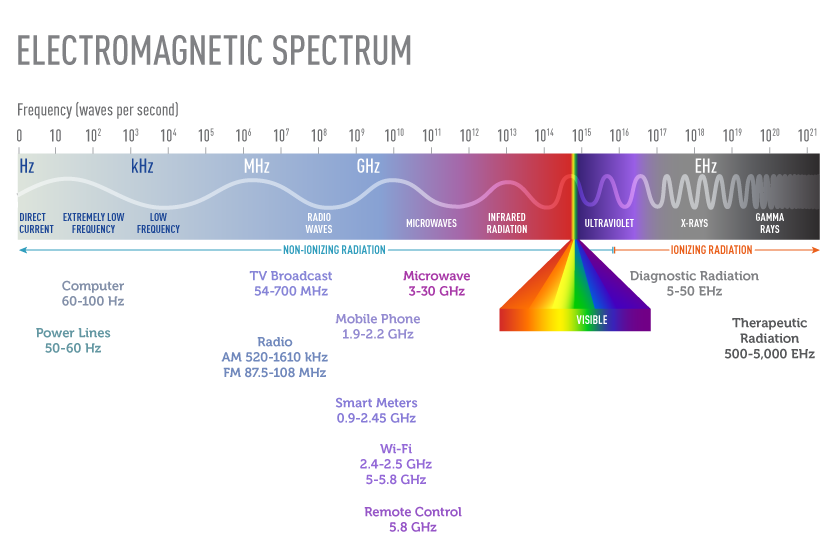
The electromagnetic spectrum represents all of the possible frequencies of electromagnetic energy. It ranges from extremely long wavelengths (extremely low frequency exposures such as those from power lines) to extremely short wavelengths (x-rays and gamma rays) and includes both non-ionizing and ionizing radiation.
Are Electric And Magnetic Fields Separate Things, Crossed Uniform Electric And Magnetic Fields, Electric And Magnetic Field Amplitude, Electric And Magnetic Field Calculation, Electric And Magnetic Field Calculations With Finite-element Methods, Electric And Magnetic Field Cannot Accelerate, Electric And Magnetic Field Components, Electric And Magnetic Field Components Of An Electromagnetic Wave, Electric And Magnetic Field Of A Moving Charge, Electric And Magnetic Field Of Dipole Antenna, Electric And Magnetic Field Of The Heart, Electric And Magnetic Field Sensors, Electric And Magnetic Field Shielding, Electric And Magnetic Field Similarities, Electric And Magnetic Field Simulator, Electric And Magnetic Field Strength, Electric And Magnetic Field Theory, Electric And Magnetic Field Transformation, Electric And Magnetic Field Transmission
Read MoreQuitting Smoking Is Easier Than Avoiding EMF Radiation
EMF 0 Comments Electromagnetic Frequencies Electromagnetic Hypersensitivity EMF-home-inspection Nashville Tennessee Home inspections
How much more proof do we need that being online isn’t healthy for us?
 The latest terrible tech research is from Kaiser Permanente, published last week in the journal Scientific Reports. In a study of hundreds of pregnant women in the Bay Area, the authors found that those who were more exposed to the kind of radiation produced by cell phones, wireless networks and power lines were nearly three times as likely to suffer miscarriages.
It goes without saying that these electromagnetic fields, or EMFs, are around every single one of us. Thanks to our insatiable demand for social media, GPS and “smart” physical devices, there will be more and more of them every year.
I was a bit surprised by the Kaiser study’s publication.
Not because I doubt its findings — it seems sensible to assume that if radiation is powerful enough to transmit data through the ether, it’s probably powerful enough to scramble our cells as well.
Plus, I live in the Bay Area.
People who don’t live here think this place is nothing more than a magnet for any and every whiz-bang tech idea.
Those of us who actually live here know that there’s a counterveiling force of skepticism to meet every single one of those ideas.
That’s why Instacart will never replace Berkeley Bowl. It’s also why San Francisco and Berkeley — cities that are awfully friendly to technology in other ways — both passed laws requiring cell phone retailers to post warning signs about radiation, citing concerns about cancer, brain tumors and reproductive health.
But there will be tremendous pushback against any research showing how dangerous this stuff may be.
An example: San Francisco’s radiation-warning law, championed by then-Mayor Gavin Newsom, passed in 2010. But after a lawsuit from the cell phone industry, the city backed off on implementing it.
Around the same time, the California Department of Public Health drew up its set of guidelines to inform the public about the risks associated with cell phone use.
The health department then sat on these guidelines — for seven years — until The Chronicle told the state it was going to publish a news story about the case, and a judge signaled that she would order them to be released.
The reason for the delay?
The health department’s lawyers claimed the agency isn’t required to warn the public of health risks that haven’t been proved (despite the fact that the information was gathered by the agency’s own scientists). The lawyers also argued that releasing the guidelines might cause the public to panic.
Well, it might be time to start panicking. More and more, it sounds like the long-term effects of our Internet habits could be dangerous, not just for our relationships and our ability to focus, but our brains and bodies as well.
To this member of the public, the small-but-growing body of EMF research looks like anti-tobacco research must have looked in the 1950s — necessary and important work that will surely gain researchers an ugly, uphill battle against better-funded opponents.
Even more disconcerting?
Once scientists knew how dangerous tobacco was, the public could clearly and simply understand how to prevent those dangers: stop smoking.
But I’m not sure there’s any way to turn back the clock on EMFs.
I read the story about Kaiser’s new study on my cell phone, traveling between my office (which is replete with Wi-Fi networks) and my home (same). I happened to be traveling on BART, so when I put my phone down I studied the passengers around me.
Every sitting passenger was hunched over their phone, as if in prayer. The strap-hangers held their phones in front of their faces; the blue screens glided through the air like fish in an aquarium. All of this was normal, if vaguely depressing; a pageant I see and participate in every day.
But I also noticed, as if for the first time, how many people were wearing wireless Airpods and other earbuds. They wore them with a certain pride of ownership, as if they were in on a secret the rest of us were yet to learn.
I watched them, and thought about the public health guidelines that went unreleased for seven years. I thought about how the guidelines suggested removing headsets as soon as calls are over, and keeping the phone away from your body.
I thought about how many recent cell phone “improvements” chip away at that guidance. Then I lifted my phone from my lap and dropped it in my bag, out of sight.
Caille Millner is a San Francisco Chronicle staff writer. Email: cmillner@sfchronicle.com Twitter: @caillemillner
Explanation Of Emf Protection Devices
EMF 0 Comments Cell Towers Electromagnetic Frequencies Electromagnetic Hypersensitivity EMF-home-inspection Safty and Remediation
 The two small words electromagnetic fields or EMF (or one small acronym depending on your direction of thought) describe something that is part of the root cause of many terrible things that are currently plaguing man at this point in time. The new and improved methods of protection from this terrible force that are constantly being invented for us are the only saving graces we have these days.
These electromagnetic fields are being created by the electricity all around us, especially by electric power lines that are a feature of our every day lives. There are ways we that we can minimize the effects that the EMF has on us, but alternatives are to invest in the protection devices that are available. The best option is to use the minimizing measures as well as the protection devices. The difference between a minimizing measure and the protection devices is that the devices are tested and have proven results while the alternate measures have evolved from household wisdom.
There are many different varieties of protection from EMF available these days. There are personal protection devices that are just for one person, there are cellular phone protection devices, devices to protect your entire home as well as many more. Each device is specifically designed to perform a certain type of protection. The use of more than one in collaboration would be recommended since this will enhance your level of protection.
Protection devices that are portable or personal will only provide protection or shielding to one person, the person wearing or carrying it. These are recommended for everyone, but especially those who are on the move a large portion of the time since they are not in a shielded environment a lot of the time, especially on the road. These EMF protection devices are either carried or worn on the person in order to be effective.
Cell phone radiation protection devices come in a variety of shapes, sizes and styles, but their purpose is the same, completely eradicate the entrance of EMF into the head. Some protection devices are designed to be applied to the backs of cellular phones and deflect EMF before they reach the head. Other devices are connected to the phone and act as a head set or hands free kit to put as much distance between the head and the phone that is emitting the fields. The utilization of both types of devices simultaneously would be recommended as the cellular phone emits large quantities of radiation.
Whole house protection devices can be utilized in homes of almost any size and they provide blanket coverage for all people within the home and as such are highly recommended, especially for families with children, for the overall coverage it provides. It is best to utilize the whole house protection device in conjunction with personal EMF protection devices for all the individuals in the home.
What is Electro Pollution/Electro-smog?
EMF 0 Comments Electromagnetic Frequencies Electromagnetic Hypersensitivity EMF-home-inspection Safty and Remediation
Radio frequency radiation is produced by cell phones and towers, cordless phones, wireless communication systems such as internet, games, alarm systems, baby monitors, smartmeters and others. Microwave ovens could actually be called radio frequency ovens.
Magnetic fields are produced by high-voltage lines and electronics, wiring errors, AC current flowing on plumbing, low voltage lighting appliances, electric motors, power transformers, baseboard heaters and fluorescent lights both large and compact.
Electric fields and body voltage are generated by lighting, switches, plugs, extension cords, power bars, TVs and other electrical devices powered by wiring in walls, ceilings, floors and outdoor areas.
Light Vibration Smog is the transmission of toxic frequencies through lightbulbs,computer screens, televisions and any other device that produces light which is transmitted to the eyes. We were designed for natural light. Since the advent of artificial light people have been suffering neurological diseases due to the frequencies transmitted.
Is Electrosmog Harming Your Health?
Read More
Unhealthy Electromagnetic Frequencies
EMF 0 Comments Electromagnetic Frequencies Electromagnetic Hypersensitivity EMF-home-inspection
Electro-magnetic fields (EMFs) are man-made and is an increasing threat in this modern world. We need to know what it is, the source of it, and how it harms in order to minimize our exposure to the health risks it poses as much as possible.
If you think you are living a rather healthy lifestyle yet are often sickly without being able to find the cause, you might be a victim of this silent killer.
There are two types of EMFs—natural and man-made. We will discuss here, the man-made EMFs that seem to pose a far greater threat to our health. They are all around us, yet we are rather oblivious to the extent of harm it can cause to our health and our family’s health. This is the dark side of technology, and the price we have to pay for modernization and convenience.
What is Electro-Magnetic Radiation (EMR)?
EMF radiations are invisible forces that occur when electrical current flows through an electrical device. Electric and magnetic fields emanate outwards and affecting everything around them.
The intensity of the field varies with voltage. The higher the voltage, the stronger the electric fields. Interaction between the electricity and magnetic fields produces electro-magnetic radiation (EMR).
Exposure to an electric field can sometimes be weakened by things around it. It can sometimes be felt, making your skin or hair tingle. However, the magnetic field travels through most things, and cannot be felt.
Radiation is an energy that takes the form of waves, spreading outwards from its source, very much like ripples in water that move outwards when a pebble is dropped into it. EMR passes through space at the speed of light at about 300 million meters per second and it interacts with things around it.
How EMFs Affect Our Health
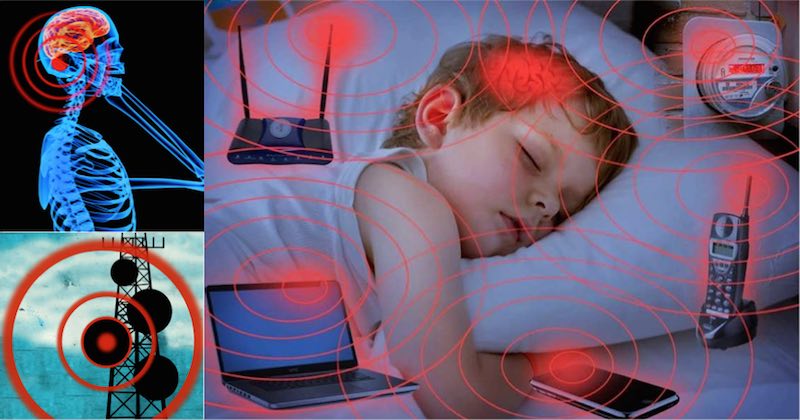
We are fundamentally electro-magnetic beings with micro electrical currents being generated to control our bodily functions such as growth, metabolism, thought, movements, etc. Disturbances to this “electrical” network in our body can cause malfunctioning of our internal organs, especially to the brain.
Exposure to consistent external frequency for more than a few minutes can cause our body’s electrical functionality to be disrupted. This is true even with exposures to very weak EMFs.
Research has documented that prolonged exposure to EMFs can reduce the brain’s protective mechanism and causes psychiatric disorders like depression, shortened attention span and insomnia. It also interferes with the body’s natural healing process.
Our human bodies are very sensitive to EMFs. When we interact with natural energies, we reinforce the natural balance within our energy system. But when we are exposed to man-made EMFs which are unnatural for our bodies, they create a chaotic situation that is harmful. Our bodies absorb and store the energy fields that weaken our immune system, resulting to various illnesses and diseases.
Some diseases linked to constant exposure to EMFs: Headaches, chronic fatigue syndrome, memory loss, miscarriages, birth defects, leukemia, lymphoma, brain tumor and even cancer.
Electro-pollution: Look at the dangers around you
Contrary to what we may think, low dose exposure doesn’t mean low risk. In fact, low level EMF exposures increase health risks!! And here are some unlikely suspects:
Wi-Fi Dangers
Wireless routers—as well as Bluetooth and similar wireless systems—give off electromagnetic radiation in the low-gigahertz frequency. This level is considered potentially dangerous to people. And the danger is compounded by several factors:
- Just like the wireless signals themselves, the EMFs can pass through walls.
- Most routers are not turned off at night, so you are exposed 24/7.
- You are not only exposed to EMFs from your own router. Did you ever search for a wireless signal and see not only your wireless network, but also your neighbor’s and the one from the business down the street? All of them emit EMFs.
Increasingly, scientists and researchers are uncovering the health risks of EMFs. Depending on the level and the length of exposure, those risks are potentially dangerous:
- Contributes to the development of insomnia
- Damages childhood development
- Affects cell growth
- Derails brain function
- Reduces brain activity
- Affects fertility
- Increases heart rate that provokes cardiac stress
- Increases risk of tumor development
Radiowaves Energy
Radiowaves are energy emitted by radio stations to receiving units in your home devices. All wireless technology has its own frequency band, like remote controllers for your automatic gate, home alarm systems, cordless phones, cell phones, radio, remote controlled toys, digital baby monitor, global positioning system (GPS), etc.
Radiowaves can produce deep heating into our body organs without affecting the skin. Non-thermal effects emanating from these devices have been proven to be even more harmful, causing: headaches, disturbance in sleep patterns, shortened attention span, increased blood pressure, damage to eyes especially when glaucoma medication are also taken, childhood leukemia, growth of cancer cells in brain, and many more.
The video clip below shows you the radiowaves emitted from ringing cell phones that can pop corns. Imagine how it can also burn your brain out !!
Safety precautions on using cell phones:
- Avoid using mobile or cordless phones for an extended period, if you can.
- If you really have to use the phone, make your calls short or use a handsfree set.
- Avoid using the phone in poor signal areas—handsets will automatically adjust to increase their broadcast power under this circumstance.
- Use an external (bluetooth) earpiece that keeps the phone away from your head.
- If you wear glasses, go for plastic frames or non-metal frames. Good conductor material can serve as an antenna to channel radiowaves directly into your brain.
Television Waves and Extremely Low Frequency (ELF)
Television sets radiate EMF in all directions when plugged in, not just while turned on. Larger screens may radiate a stronger field that can even penetrate walls. Video display terminals (VDTs) are included in this category, emitting very low frequency which interferes with our internal electrical system.
Other devices that emit ELF: Computers, laser printers, photocopiers, electric blankets, electric clocks.
Computer: According to Peggy Bentham in her book VDU Terminal Sicknesses, she mentioned eight type of EMR from computers. (And I’m also exposed to the risks as I create this website.):
- X-rays, stronger in color VDUs
- Ultraviolet radiation
- Infrared radiation
- Microwaves
- Radio waves
- Extremely low frequency
- Very low frequency fields
- Static electricity
Some of the health risks from long-term exposure to computers and VDUs: miscarriages, low birth weights, eye problems, hearing problem, suppressed immune system, hyperactivity in young children, skin irritation, etc.
Safety Precautions on Using TVs and VDUs:
- Sit at least 24 inches away (ideal) from the screen.
- EMFs radiate from all sides of the computer, especially from the top and back. Sit at least 3 feet away from a computer that is in operation.
- Avoid working at the VDU for more than 2 hours a day (rather impossible for me!)
- Switch off the power of your TV or computer when not in use.
- Wear UV-protection eye glasses if possible, to reduce the UV radiation that can cause cataract.
- Put some live plants next to your computer. The leaves can help absorb some infrared radiation and produce negative ions that are necessary for our bodies.
Power Stations
Power transmission lines carry very high voltages and emit both electrical and magnetic fields. How close is YOUR home to power lines? A safe distance is about 1,000 feet away.
Substations might be closer to home and they give off very high magnetic fields.
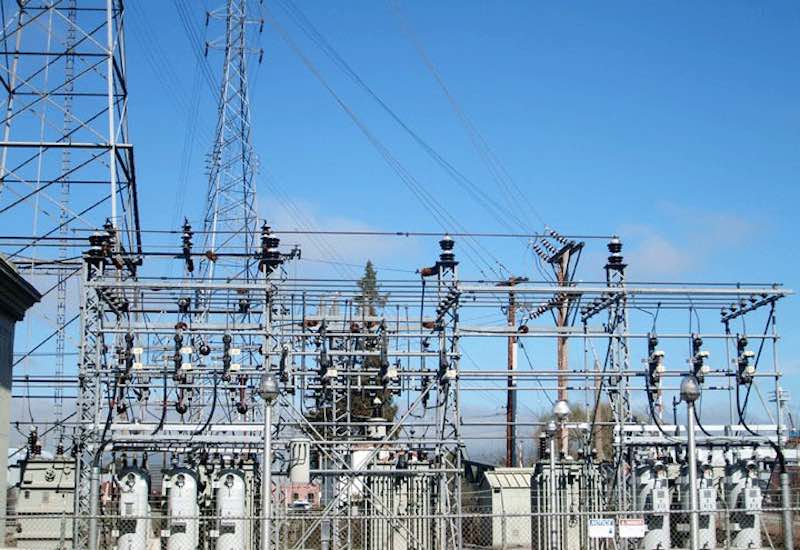
EMFs emitted from your neighborhood transformer are rather high too, but due to its small structure, the field strength diminishes rapidly with distance. So, the further your home is from any power stations or neighborhood transformer, the better.
All of us walking on the street may be exposed to EMFs from these transmission lines. Scientific studies have found a link between increased rates of cancer and proximity to power lines.
Another study by epidemiologist, Dr Nancy Wertheimer from the University of Colorado, showed that children living near these backyard power lines had 3 times the likelihood of developing childhood leukemia and cancer. Children are more susceptible to exposure to EMFs.
Many other studies have confirmed her findings and found increased risk of leukemia, lymphomas, brain tumor, cancer of the brain and nervous system. There are also links of EMFs and other mysterious diseases, sudden death of babies, fatigue, extreme headaches, disorders of the central nerve system and exhaustion.
Dangers in the Medical Field
Diagnostic X-rays and scans expose you to unnecessary radiation. Professor and Director of Medical Physics at Hammersmith Hospital in London wrote: “Medical irradiation is by far the largest man-made contribution to the radiation burden of the population of developed countries.”
X-rays
X-rays are ionizing radiation that are damaging. There is no such thing as a “safe” X-ray. The few kinds of X-rays: mammograms, bone X-rays, dental X-rays, CT scans and fluoroscopy.
X-rays have higher energy than light waves that can pass through the body. The high energy radiation can cause damage to cells in the body, which increases the risk of developing cancer. Even though the risk is rather low, it increases with the increasing number of X-rays you are exposed to during your lifetime.
CT Scan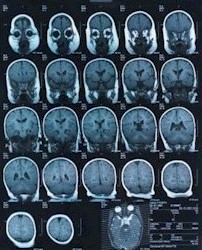 CT (computerized tomography) scan is a moving beam of X-rays that create a 3-dimensional picture, (e.g. the brain). And because it shoots so many fine-beam X-rays all at one, the dose of radiation received is much higher than that of a standard X-ray.
Radiation exposure does most damage to cells during rapid growth, therefore, babies and young children are at a far greater risk from these exposures.
Mammography
The ionizing radiation in mammography poses cumulative cancer risks. The radiation absorbed dose (RAD) is about 1,000 times more than a chest X-ray. If a pre-menopausal woman undergoes annual screening over a 10-year period, it would have exposed her to 10 RADs on each breast, bringing the cumulative risk to 10%.
Breast tissues are extremely susceptible to radiation-induced cancer. So, you can see that mammograms can initiate the very breast cancer that women want to avoid by taking annual mammograms!! Avoid it at all costs.
Hazards in Our Households
Most household electrical appliances also emit EMFs but at a much lower risk. Here is a highlight of some:
- Fluorescent light: emits EMR at the energies of visible and UV light. Prolonged exposure has been found to cause red blood cells to clump together, reducing alertness, causing a tired feeling. Always opt for natural sunlight where possible.
- Electric clocks that comes with a radio have a moderately high EMF. Avoid putting these at your bedside if possible.
- Electric blankets create EMFs that can penetrate 6-7 inches into the body. An epidemiological study has linked electric blankets with miscarriages and childhood leukemia.
- Other electrical items emitting low-level EMF: hair dryer, electric shaver, hair dryer, vacuum cleaner, microwave oven, washing machine, dishwasher, refrigerator, etc.
Safety Precautions You Can Take At Home:
- Grow some plants indoors. Plants are natural eco-friendly air purifiers and their leaves can help absorb some infrared radiation and produce negative ions that are necessary for our bodies.
- Detoxify radiation with clay bath and green juices.
- Practice grounding every day to detoxify and discharge radiation from your body.
- Use electrical items for only brief periods. Switch off the power of all electronic items when not in use, including your router.
- Even though laptops are called such because they are used on the laps, use it on a desk instead, to protect your reproductive system health.
- Remove all electrical appliances at least 6 feet away from your bed.
- Do not put your cell phone under your pillow as an alarm clock. It emits EMF even when not in use.
- Avoid prolonged exposure of your children to television, computers and tablets.
- Minimize the use of electrical devices like the radio and microwave oven. Turn off the power when not in use.
Top 8 radiation sources at your home
EMF 0 Comments Electromagnetic Frequencies Electromagnetic Hypersensitivity Safty and Remediation
That tower, outside your home should concern you and rightly so. But did you ever stop to fret about the radiation from your cellphone or WiFi or Stabilizer or even from your electric shaver?
As much as Internet and telecommunication have become the part of our modern lives, Cell towers have become a feature of city skylines. The profusion of cellular technology and cell towers have caused a concern on the health impact of radiation of humans. Even as cell phone towers are the most visible sources of radiation – there are greater issues and sources of radiation in our homes, offices, and other life spaces that we are unaware of and are blind-sided to.
Look around yourself and make a note of the number of wireless, technology and electronics devices, products around yourself. Close your eyes and think of your mother’s time – how many of these devices would have been there in her time. Your grandmother? In 3 generations – the world has changed for the better and the worse. These devices emit radiation (of different intensities) most of which is not very healthy. With the advent of 24*7 hyper connectivity, IoT, Smart homes, Home automation, our exposure to such radiation is only going to compound manifold.Depending upon our lifestyles and habits, we have multiplied our ElectroMagnetic (EMF) Radiation exposures from 100X (hundred-fold) to 10,00,000X (million-fold).
Any device running on electricity generates an Electro-Magnetic field (EMF) around itself. Prolonged exposure to any such EMF is associated as a health risk. Epidemiological research has consistently associated high EMF with health effects (including cancer). These health risks include Autism in children, enhanced risks of Parkinson’s and Alzhemier’s; and infertility in adults. While the evidence linking EMF radiation to these health hazards is scratchy and not well formed, a precautionary approach will be prudent. The risk from EMF is compounded by the fact that it is invisible and insensible.
Here’s a list of the top 8 EMF radiation sources at your home. Check yourself on these device EMF parameters.
1. Cellphone
A mobile phone is the most personal device ever, and incidentally, a mini-microwave that you are carrying around.
Risk Profile: Radiation from a mobile phone increases exponentially in low coverage areas, or shadow zones. The biggest risk is the proximity of a mobile phone – it radiates at close quarters to the brain.
Hack : Use an earpiece. It helps negate upto 98% of cell phone radiation
2. WiFi
While we have problems with cell towers outside, ironically, we are at ease with a mini cell tower in home. A WiFi after-all is a mini cell tower.
Risk Profile: WiFis are seldom switched off. Therefore we have a low din- consistent and perpetual radiation exposure.
Hack : Switch it off when not in use. Try using Wired internet wherever possible.
3. Stabilizer/Inverter
These “purchase and forget” appliances are the highest sources of in-premise EMF. The older these appliances, the greater the EMF.
Risk Profile: These devices co-habit living spaces and create high EMF even at 3-5 feet distances. Do you have a stabilizer in your bedroom? Spending long hours in your day beside these appliances and that is a key risk.
Hack : Remove stabilizer from your bedroom. Relocate inverter to any covered area outside home.
4. Old electric circuitry
EMF from electrical circuitry inside old constructions and houses can create a consistent EMF.
Risk Profile: EMF from electrical sources is stubborn and consistent. By nature residents have 24*7 exposures.
Hack : Extremely difficult to do away with. Old wiring needs to be changed with new one.
5. Electric Shaver, Hair Dryer
These personal devices have an extremely localized EMF and are more prone to create damage due to proximity during-use.
Risk Profile: High EMF at proximity points. The tip/nozzle of these appliances can generate upto 70/100mG EMF.
Hack : Use sparingly. If using the hair dryer – maintain atleast 1 feet distance between the head and the nozzle.
6. Power distribution equipment outside your home
Most of our cities and colonies/RWAs have archaic power distribution equipment. Such Infrastructure has very high EMF and flout norms of public safety otherwise as well.
Risk Profile: As with old electric circuitry at home, old power distribution equipments (HT lines, transformers) are extremely stubborn EMF sources. The EMF could be significantly high as well and are perpetual in nature.
Hack : Maintain a minimum distance of separation of 50-100 feet from such sources.
7. Laptops
A laptop carries both radiation as well as EMF profile.
Risk Profile: The underside of a laptop has a very high EMF exposure at point of contact and high proximities and can be harmful for adult fertility
Hack : Use a laptop radiation shield to reduce exposure to device radiation from laptops.
What is EMF / EMR / ELF / RF
EMF 0 Comments AC/DC Magnetic Fields Electromagnetic Frequencies EMF-home-inspection
Our main emphasis here is to define a number of acronyms such as EMF, ELF and EMR. However, we really should start at the beginning, using the small building blocks strewn about this page and begin building the foundation that will allow you to fully understand the meaning behind the acronyms that are so much a part of our everyday lives.
You cannot have EMF (Electrical Magnetic Fields) or EMR (Electromagnetic Radiation) without electricity. With that in mind, let’s learn a little bit about the wonderful tool called electricity. I called electricity a tool because, like a tool, it provides us with the means to alter our environment in a manner that pleases us, with a modicum of effort. I, for one, love the usefulness of electricity, especially in the winter when I can simply turn on a heater as opposed to chopping wood for a fire.
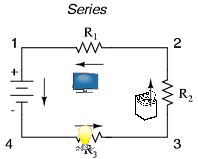 The diagram above is of a simple electrical circuit. The symbol on the left side with the + at the top and the — below represents a battery. The lines that make up the rectangle are the electrical wires. R1, R2,R3 represent resistors in our circuit which in turn can represent a light bulb a TV set and the washing machine. Now, in real life we would be using AC (alternating current), electrical power generated at the power station and transferred to us via very large cables high up on very tall poles, but for the sake of simplicity we are using a very, very large battery. Looking at the batteries bottom we notice the minus sign which signifies the negative node of the battery (the flat end on a AA). In this crazy circuit if you want the TV to work (R1), then the washing machine (R2) must be on, as well as the lamp (R3). This circuit is called a series circuit and should remind you of the early kinds of Christmas lights. Remember how frustrating it was to have one little bulb go bad and the whole string of lights would not work? Back to business, very tiny parts of an atom, called electrons, are bunched up on the plate next to the minus sign. What those electrons are doing is waiting for all three devices to be switched on so they can begin their race through all of the devices and wires just to make if back to the positive side of the battery. Once everything is turned on, the electrons start moving very quickly to R3. R3 is the lamp and for all those electrons to get past R3 they must travel up the lamps wire and enter the filament in the light bulb.
The filament is very thin compared to the lamp cord. Once the electrons arrive at the light bulb, a problem occurs. All of those electrons start pushing and shoving each other trying to make it through the thin wire. The more the electrons push and shove each other trying to gain access the hotter they become. Eventually they get so hot they turn the light bulbs filament red which, in turn, illuminates the bulb. Next, the electrons race toward the washing machine with a little less zip as some of the voltage was left behind to continue lighting the lamp. As I mentioned before the washing machine is on and is waiting for something to come along and make water start filling up the tub. When the electrons arrive they encounter a metal block on which their wire is wound. Their wire is wound around the metal block over 1,000 times, around and around. The electrons start running through the wire going around and around. An instant later, something magnificent happens. The electrons (current), flowing around and around inside the wire, turn the metal block into a magnet. That’s right, into a magnet, just like those giant magnets you see pulling wrecked cars up into the air, only smaller. Once the block becomes a magnet, it acts like all other magnets searching for another piece of metal that is opposite in polarity to pull towards it. As luck would have it, a cylindrical metal plunger is nearby becoming instantly attracted to the magnet that has just shown up. The plunger slams itself backwards into the magnetic block and then it happens. When the metal plunger slams backward becoming attached to the metal at the rear of its casing you can see that the plunger has left a large hole behind, which it had been plugging up, just a millisecond before. The plunger had been holding back the water from entering the washing machine; much like the boy who saved his town from a broken dike by pushing his thumb into the hole, saving his town from flooding. Let’s see how the electrons are doing. They have lit the light bulb and they have allowed water to start filling up the washing machine, but where are those electrons now? The electrons having completed the washing machine task continue flowing toward the positive end of the battery, leaving additional voltage behind. They still have a TV to go through and turn on and luckily the TV requires only 12 Volts to operate, because that is all of the voltage left after turning on and leaving behind a considerable amount of voltage. The electrons make quick work of this last job by turning on a relay, which in turn allows electricity to flow throughout the TV, quickly bringing it to life. Finally, it seems like it took forever to get everything turned on, but listen to this next part carefully. From the moment we supplied electricity to the circuit, until the time all three appliances were running, perhaps ten milliseconds had gone by (a millisecond is 1/1000 of a second). Electricity flows slower than the speed of light but not by much.
| Great news, you now know how electricity works. I will admit there are a few minor parts I glossed over, but for the most part that is how electricity, makes things work. We either use electrons to make things very hot, like in the light bulb, or we make the electrons run around and around a metal object to create a magnet. Now that you know the basics of electricity using a DC battery (direct current), I will be able to zip right through the few differences in using AC (alternating current.) |
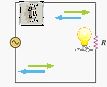
Let’s go ahead and show you the differences an AC circuit has compared to our earlier DC circuit. In our DC circuit example we had 3 appliances. Once we turned the power on in that circuit all of the appliances began working. Well, working until the battery went dead; which would not take very long with a battery running a washing machine. Because batteries are not practical for running major appliances due to their inherent limitations of running out of power, we need a more practical power source. In walks AC, our alternating current alternative to the very limited DC. Power plants around the globe are generating AC power to run our homes and businesses. We will examine some negative aspects of AC power in another section of the website but, for now, let’s get back to learning about electricity. In the accompanying circuit diagram all you see is a symbol for AC power and one lone resistor which we will say is our lamp from earlier. A wall switch has been added to turn on the lamp and arrows are marking the direction of electron flow. Notice the arrows going in both directions unlike the one direction in our DC example. AC or alternating current is switching the direction of the electrons back and forth at the rate of once every 1/60th of a second. When the lamp is switched on and AC power is applied, the light bulb illuminates just like it did in the DC circuit. The difference is in the DC circuit the lamp stayed on continuously until the battery went dead. In our AC circuit our lamp turned on, but the lamp went off, then back on again, 1/60th of a second later. This on and off of the light bulb in our lamp is caused by the rising and falling of the voltage coming into our house. The good part about the lamp going on and off is that it happens so quickly. In other words our electricity follows a very specific timing or frequency. The frequency in America of our AC current is 60 hertz, which means the electricity in our homes go from on to off and back to on in 1/60th of a second.
The speed at which our lamp is being turned on and off again is simply too fast for the information to get from our eyes to our brain. We conveniently never see the lamp go off. In Europe their household electrical frequency is 50 hertz or 10 cycles slower than ours. Even at 50 hertz our eyes and brain cannot discern the change in the state of the light bulb. As far as frequencies go the 60 hertz that our household electricity operates is very low. The opposite to that low frequency of electricity would be a communication device like your cordless phone. Most cordless phones operate at a frequency in the billionths of a second.
The most common right now is the 5.8 gigahertz cordless phone. By the way, did you notice just now how much you have learned? When I mentioned our house electricity at 60 hertz and then jumped to the 5.8 gigahertz cordless phone you didn’t even flinch, because you understand what frequencies mean, congratulations. Now that you have a firm hold on electricity and how it moves through a circuit and at what frequency it operates, we can go on to the next subject which includes EMF (electrical and magnetic fields), EMR (electromagnetic radiation), and ELF (extremely low frequencies).
Read MoreElectric & Magnetic Fields
EMF 0 Comments AC/DC Magnetic Fields Electromagnetic Frequencies EMF-home-inspection
Electric and magnetic fields (EMFs) are invisible areas of energy, often referred to as radiation , that are associated with the use of electrical power and various forms of natural and man-made lighting. EMFs are typically characterized by wavelength or frequency into one of two radioactive categories:
- Non-ionizing: low-level radiation which is generally perceived as harmless to humans
- Ionizing: high-level radiation which has the potential for cellular and DNA damage
| Radiation Type | Definition | Forms of Radiation | Source Examples |
|---|---|---|---|
| Non-Ionizing | Low to mid-frequency radiation which is generally perceived as harmless due to its lack of potency. |
|
|
| Ionizing | Mid to high-frequency radiation which can, under certain circumstances, lead to cellular and or DNA damage with prolonged exposure. |
|
|

Can EMFs be harmful to my health?
During the 1990s, most EMF research focused on extremely low frequency exposures stemming from conventional

power sources, such as power lines, electrical substations, or home appliances. While some of these studies showed a possible link between EMF field strength and an increased risk for childhood leukemia , their findings indicated that such an association was weak. Now, in the age of cellular telephones, wireless routers, and portable GPS devices (all known sources of EMF radiation), concerns regarding a possible connection between EMFs and adverse health effects still persists, though current research1 continues to point to the same weak association.
Additionally, the few studies that have been conducted on adults show no evidence of a link between EMF exposure and adult cancers, such as leukemia, brain cancer, and breast cancer. Nevertheless, NIEHS recommends continued education on practical ways of reducing exposures to EMFs.
Does my cell phone emit EMF radiation?
Measured in units called hertz, cell phone emissions, a form of radiofrequency radiation, exist at the lower end of the non-ionizing radiation spectrum at the 900-1900 megahertz range. At present, the weight of the current scientific evidence has not conclusively linked cell phone use with any adverse health problems, though scientists admit that more research is needed. To that end, the National Toxicology Program (NTP), headquartered at NIEHS, is leading the largest laboratory rodent study, to date, on cell phone radiofrequency exposure, the complete findings are expected to be released by the end of 2017. Partial findings from the completed rat studies were released in 2016.
To learn more about these NTP partial findings and the cell phone radiofrequency rodent studies, visit the NIEHS Environmental Health Topics page on cell phones.
What if I live near a power line?
It is important to remember that the strength of a magnetic field decreases dramatically with increasing distance from the source. This means that the strength of the field reaching a house or structure will be significantly weaker than it was at its point of origin, as you can see below. For more information, see the NIEHS educational booklet, “EMF: Electric and Magnetic Fields Associated with the Use of Electric Power.”. This booklet, prepared in 2002, contains the most recent NIEHS research on health and powerline electric and magnetic fields. The World Health Organization website has information prepared in 2010. For example, a magnetic field measuring 57.5 milligauss immediately beside a 230 kilovolt transmission line measures just 7.1 milligauss at a distance of 100 feet, and 1.8 milligauss at a distance of 200 feet.
 How can I find out if I’m being exposed to EMFs?
If you are concerned about EMFs emitted by a power line or substation in your area, you can contact your local power company to schedule an on-site reading. You can also measure EMFs yourself with the use of a gaussmeter, which is available for purchase online through a number of retailers.
This content is available to use on your website.
Please visit NIEHS Syndication to get started.
Additional Resources
- Electromagnetic Fields and Cancer – National Cancer Institute
- Extremely Low Frequency Fields – Environmental Health Criteria Monograph No.238 from the World Health Organization (WHO)
- IARC Classifies Radiofrequency Electromagnetic Fields as Possibly Carcinogenic to Humans – The WHO/International Agency for Research on Cancer (IARC) has classified radiofrequency electromagnetic fields as possibly carcinogenic to humans (Group 2B), based on an increased risk for glioma, a malignant type of brain cancer1, associated with wireless phone use.
- NIEHS Report on Health Effects from Exposure to Power-Line Frequency Electric and Magnetic Fields: Prepared in Response to the 1992 Energy Policy Act (PL 102-486, Section 2118)(751KB) – Prepared in Response to the 1992 Energy Policy Act (PL 102-486, Section 2118)
- Questions and Answers about Biological Effects and Potential Hazards of Radiofrequency Electromagnetic Fields – Federal Communications Commission Office of Engineering & Technology
- Radiofrequency Background – U.S. Food and Drug Administration
- RadTown – Learn about radiation in your town: where it is and how it’s used. Explore the Burbs, Countryside, Downtown or Waterfront. Just pick and click! From the U.S. Environmental Protection Agency
- Workplace Safety and Health Topics: EMF (ELECTRIC AND MAGNETIC FIELDS) – The National Institute for Occupational Safety and Health (NIOSH)