Category: AC/DC Magnetic Fields
EMF Home Inspection focus on sleeping areas and places where your family spends the most time.
Sleep EMF RF Radio Frequency
EMF 0 Comments AC/DC Magnetic Fields EMF-home-inspection
Sleep quality and health being negatively affected due to relationship between Sleep EMF RF (radio frequency) being pumped into our ionosphere at rate of billions of Watts per hour 24 / 7. W.O. Schumann a German physicist, discovered in 1952 that there is a resonant cavity between the earth’s surface and the ionosphere containing a frequency modulated electromagnetic field in the spectrum from below 1 Hz to more than 100 Hz. Notice in the graph below that the amplitude of the dominant frequencies of these “Schumann Waves” is below 14 Hz.
Sleep quality and health being negatively affected due to relationship between Sleep EMF RF (radio frequency) being pumped into our ionosphere at rate of billions of Watts per hour 24 / 7. W.O. Schumann a German physicist, discovered in 1952 that there is a resonant cavity between the earth’s surface and the ionosphere containing a frequency modulated electromagnetic field in the spectrum from below 1 Hz to more than 100 Hz. Notice in the graph below that the amplitude of the dominant frequencies of these “Schumann Waves” is below 14 Hz. 
Notice also the distinct peaks in the Delta range heretofore mistakenly not “recognized” Schumann frequencies. In the past I’d called these 1.5 and 2.5 Hz. Now there is good reason to believe those small peaks are 1.2 and 2.4 Hz.
The Russian Space Agency discovered that Schumann- wave generators in space craft (formerly void of fluctuating magnetic fields) improved the health and well being of astronauts on extended space voyages; especially effects upon bone density. N.A.S.A. included them in the design of the Space Station to fend off osteoporosis, muscle wasting and other effects of zero gravity during extended Station missions because it works. The $4K – $5K QRS system claims to be going to space with NASA.
Although peer reviewed studies show astounding anti-osteoporosis / bone wasting effects, the FDA has effectively sidelined this simple technology for routine, age-related bone loss.
We are describing a very narrow healthy frequency band where frequencies above 15 Hz have been shown in dozens of frequency specific animal studies to cause negative behavioral modification; above 20 Hz to cause stress hormone production. You’ll notice that the highest amplitude peak in the graph below is (as it should be) 7.8 Hz and is what most people mistakenly believe is “THE” Schumann resonance. In reality Schumann resonance is a SPECTRUM of frequencies with the majority of its amplitude below 15 Hz, and with peaks at around 1 Hz, 2.5 Hz, 7.8 Hz, 14.1 Hz, 20.3 Hz, and higher. You’ll see below this is no longer true.
What is EMF / EMR / ELF / RF
EMF 0 Comments AC/DC Magnetic Fields Electromagnetic Frequencies EMF-home-inspection
Our main emphasis here is to define a number of acronyms such as EMF, ELF and EMR. However, we really should start at the beginning, using the small building blocks strewn about this page and begin building the foundation that will allow you to fully understand the meaning behind the acronyms that are so much a part of our everyday lives.
You cannot have EMF (Electrical Magnetic Fields) or EMR (Electromagnetic Radiation) without electricity. With that in mind, let’s learn a little bit about the wonderful tool called electricity. I called electricity a tool because, like a tool, it provides us with the means to alter our environment in a manner that pleases us, with a modicum of effort. I, for one, love the usefulness of electricity, especially in the winter when I can simply turn on a heater as opposed to chopping wood for a fire.
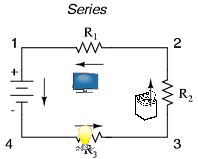 The diagram above is of a simple electrical circuit. The symbol on the left side with the + at the top and the — below represents a battery. The lines that make up the rectangle are the electrical wires. R1, R2,R3 represent resistors in our circuit which in turn can represent a light bulb a TV set and the washing machine. Now, in real life we would be using AC (alternating current), electrical power generated at the power station and transferred to us via very large cables high up on very tall poles, but for the sake of simplicity we are using a very, very large battery. Looking at the batteries bottom we notice the minus sign which signifies the negative node of the battery (the flat end on a AA). In this crazy circuit if you want the TV to work (R1), then the washing machine (R2) must be on, as well as the lamp (R3). This circuit is called a series circuit and should remind you of the early kinds of Christmas lights. Remember how frustrating it was to have one little bulb go bad and the whole string of lights would not work? Back to business, very tiny parts of an atom, called electrons, are bunched up on the plate next to the minus sign. What those electrons are doing is waiting for all three devices to be switched on so they can begin their race through all of the devices and wires just to make if back to the positive side of the battery. Once everything is turned on, the electrons start moving very quickly to R3. R3 is the lamp and for all those electrons to get past R3 they must travel up the lamps wire and enter the filament in the light bulb.
The filament is very thin compared to the lamp cord. Once the electrons arrive at the light bulb, a problem occurs. All of those electrons start pushing and shoving each other trying to make it through the thin wire. The more the electrons push and shove each other trying to gain access the hotter they become. Eventually they get so hot they turn the light bulbs filament red which, in turn, illuminates the bulb. Next, the electrons race toward the washing machine with a little less zip as some of the voltage was left behind to continue lighting the lamp. As I mentioned before the washing machine is on and is waiting for something to come along and make water start filling up the tub. When the electrons arrive they encounter a metal block on which their wire is wound. Their wire is wound around the metal block over 1,000 times, around and around. The electrons start running through the wire going around and around. An instant later, something magnificent happens. The electrons (current), flowing around and around inside the wire, turn the metal block into a magnet. That’s right, into a magnet, just like those giant magnets you see pulling wrecked cars up into the air, only smaller. Once the block becomes a magnet, it acts like all other magnets searching for another piece of metal that is opposite in polarity to pull towards it. As luck would have it, a cylindrical metal plunger is nearby becoming instantly attracted to the magnet that has just shown up. The plunger slams itself backwards into the magnetic block and then it happens. When the metal plunger slams backward becoming attached to the metal at the rear of its casing you can see that the plunger has left a large hole behind, which it had been plugging up, just a millisecond before. The plunger had been holding back the water from entering the washing machine; much like the boy who saved his town from a broken dike by pushing his thumb into the hole, saving his town from flooding. Let’s see how the electrons are doing. They have lit the light bulb and they have allowed water to start filling up the washing machine, but where are those electrons now? The electrons having completed the washing machine task continue flowing toward the positive end of the battery, leaving additional voltage behind. They still have a TV to go through and turn on and luckily the TV requires only 12 Volts to operate, because that is all of the voltage left after turning on and leaving behind a considerable amount of voltage. The electrons make quick work of this last job by turning on a relay, which in turn allows electricity to flow throughout the TV, quickly bringing it to life. Finally, it seems like it took forever to get everything turned on, but listen to this next part carefully. From the moment we supplied electricity to the circuit, until the time all three appliances were running, perhaps ten milliseconds had gone by (a millisecond is 1/1000 of a second). Electricity flows slower than the speed of light but not by much.
| Great news, you now know how electricity works. I will admit there are a few minor parts I glossed over, but for the most part that is how electricity, makes things work. We either use electrons to make things very hot, like in the light bulb, or we make the electrons run around and around a metal object to create a magnet. Now that you know the basics of electricity using a DC battery (direct current), I will be able to zip right through the few differences in using AC (alternating current.) |
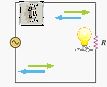
Let’s go ahead and show you the differences an AC circuit has compared to our earlier DC circuit. In our DC circuit example we had 3 appliances. Once we turned the power on in that circuit all of the appliances began working. Well, working until the battery went dead; which would not take very long with a battery running a washing machine. Because batteries are not practical for running major appliances due to their inherent limitations of running out of power, we need a more practical power source. In walks AC, our alternating current alternative to the very limited DC. Power plants around the globe are generating AC power to run our homes and businesses. We will examine some negative aspects of AC power in another section of the website but, for now, let’s get back to learning about electricity. In the accompanying circuit diagram all you see is a symbol for AC power and one lone resistor which we will say is our lamp from earlier. A wall switch has been added to turn on the lamp and arrows are marking the direction of electron flow. Notice the arrows going in both directions unlike the one direction in our DC example. AC or alternating current is switching the direction of the electrons back and forth at the rate of once every 1/60th of a second. When the lamp is switched on and AC power is applied, the light bulb illuminates just like it did in the DC circuit. The difference is in the DC circuit the lamp stayed on continuously until the battery went dead. In our AC circuit our lamp turned on, but the lamp went off, then back on again, 1/60th of a second later. This on and off of the light bulb in our lamp is caused by the rising and falling of the voltage coming into our house. The good part about the lamp going on and off is that it happens so quickly. In other words our electricity follows a very specific timing or frequency. The frequency in America of our AC current is 60 hertz, which means the electricity in our homes go from on to off and back to on in 1/60th of a second.
The speed at which our lamp is being turned on and off again is simply too fast for the information to get from our eyes to our brain. We conveniently never see the lamp go off. In Europe their household electrical frequency is 50 hertz or 10 cycles slower than ours. Even at 50 hertz our eyes and brain cannot discern the change in the state of the light bulb. As far as frequencies go the 60 hertz that our household electricity operates is very low. The opposite to that low frequency of electricity would be a communication device like your cordless phone. Most cordless phones operate at a frequency in the billionths of a second.
The most common right now is the 5.8 gigahertz cordless phone. By the way, did you notice just now how much you have learned? When I mentioned our house electricity at 60 hertz and then jumped to the 5.8 gigahertz cordless phone you didn’t even flinch, because you understand what frequencies mean, congratulations. Now that you have a firm hold on electricity and how it moves through a circuit and at what frequency it operates, we can go on to the next subject which includes EMF (electrical and magnetic fields), EMR (electromagnetic radiation), and ELF (extremely low frequencies).
Read MoreElectric & Magnetic Fields
EMF 0 Comments AC/DC Magnetic Fields Electromagnetic Frequencies EMF-home-inspection
Electric and magnetic fields (EMFs) are invisible areas of energy, often referred to as radiation , that are associated with the use of electrical power and various forms of natural and man-made lighting. EMFs are typically characterized by wavelength or frequency into one of two radioactive categories:
- Non-ionizing: low-level radiation which is generally perceived as harmless to humans
- Ionizing: high-level radiation which has the potential for cellular and DNA damage
| Radiation Type | Definition | Forms of Radiation | Source Examples |
|---|---|---|---|
| Non-Ionizing | Low to mid-frequency radiation which is generally perceived as harmless due to its lack of potency. |
|
|
| Ionizing | Mid to high-frequency radiation which can, under certain circumstances, lead to cellular and or DNA damage with prolonged exposure. |
|
|

Can EMFs be harmful to my health?
During the 1990s, most EMF research focused on extremely low frequency exposures stemming from conventional

power sources, such as power lines, electrical substations, or home appliances. While some of these studies showed a possible link between EMF field strength and an increased risk for childhood leukemia , their findings indicated that such an association was weak. Now, in the age of cellular telephones, wireless routers, and portable GPS devices (all known sources of EMF radiation), concerns regarding a possible connection between EMFs and adverse health effects still persists, though current research1 continues to point to the same weak association.
Additionally, the few studies that have been conducted on adults show no evidence of a link between EMF exposure and adult cancers, such as leukemia, brain cancer, and breast cancer. Nevertheless, NIEHS recommends continued education on practical ways of reducing exposures to EMFs.
Does my cell phone emit EMF radiation?
Measured in units called hertz, cell phone emissions, a form of radiofrequency radiation, exist at the lower end of the non-ionizing radiation spectrum at the 900-1900 megahertz range. At present, the weight of the current scientific evidence has not conclusively linked cell phone use with any adverse health problems, though scientists admit that more research is needed. To that end, the National Toxicology Program (NTP), headquartered at NIEHS, is leading the largest laboratory rodent study, to date, on cell phone radiofrequency exposure, the complete findings are expected to be released by the end of 2017. Partial findings from the completed rat studies were released in 2016.
To learn more about these NTP partial findings and the cell phone radiofrequency rodent studies, visit the NIEHS Environmental Health Topics page on cell phones.
What if I live near a power line?
It is important to remember that the strength of a magnetic field decreases dramatically with increasing distance from the source. This means that the strength of the field reaching a house or structure will be significantly weaker than it was at its point of origin, as you can see below. For more information, see the NIEHS educational booklet, “EMF: Electric and Magnetic Fields Associated with the Use of Electric Power.”. This booklet, prepared in 2002, contains the most recent NIEHS research on health and powerline electric and magnetic fields. The World Health Organization website has information prepared in 2010. For example, a magnetic field measuring 57.5 milligauss immediately beside a 230 kilovolt transmission line measures just 7.1 milligauss at a distance of 100 feet, and 1.8 milligauss at a distance of 200 feet.
 How can I find out if I’m being exposed to EMFs?
If you are concerned about EMFs emitted by a power line or substation in your area, you can contact your local power company to schedule an on-site reading. You can also measure EMFs yourself with the use of a gaussmeter, which is available for purchase online through a number of retailers.
This content is available to use on your website.
Please visit NIEHS Syndication to get started.
Additional Resources
- Electromagnetic Fields and Cancer – National Cancer Institute
- Extremely Low Frequency Fields – Environmental Health Criteria Monograph No.238 from the World Health Organization (WHO)
- IARC Classifies Radiofrequency Electromagnetic Fields as Possibly Carcinogenic to Humans – The WHO/International Agency for Research on Cancer (IARC) has classified radiofrequency electromagnetic fields as possibly carcinogenic to humans (Group 2B), based on an increased risk for glioma, a malignant type of brain cancer1, associated with wireless phone use.
- NIEHS Report on Health Effects from Exposure to Power-Line Frequency Electric and Magnetic Fields: Prepared in Response to the 1992 Energy Policy Act (PL 102-486, Section 2118)(751KB) – Prepared in Response to the 1992 Energy Policy Act (PL 102-486, Section 2118)
- Questions and Answers about Biological Effects and Potential Hazards of Radiofrequency Electromagnetic Fields – Federal Communications Commission Office of Engineering & Technology
- Radiofrequency Background – U.S. Food and Drug Administration
- RadTown – Learn about radiation in your town: where it is and how it’s used. Explore the Burbs, Countryside, Downtown or Waterfront. Just pick and click! From the U.S. Environmental Protection Agency
- Workplace Safety and Health Topics: EMF (ELECTRIC AND MAGNETIC FIELDS) – The National Institute for Occupational Safety and Health (NIOSH)