Is It Possible for You to Be Allergic to Wi-Fi?

Can people actually be allergic to Wi-Fi? Some claim you can and it even has its own official name, Electromagnetic Hypersensitivity Syndrome.

Hypersensitivity Syndrome.

Wi-Fi and other free to air electromagnetic waves had long been the subject of suspected detrimental health effects. Some even believe they are in some way allergic to Wi-Fi. Unexplained bouts of headaches, dizziness, and even skin irritation have begun to be blamed on some form of severe discomfort or hypersensitivity to electromagnetic fields. The condition has come to be known as electromagnetic hypersensitivity syndrome, or EHS for short, by the World Health Organization.

One recent case of a 15-year old girl from the UK claims that she committed suicide because of her exposure to Wi-Fi signals. Her family claimed that signals at her school made her feel physically sick as well as suffer from blinding headaches. So bad were these, it is claimed, that she found it hard to concentrate. The case was actually reported on by the Daily Mirror.

 Another survey of people who claimed to suffer from EHS described physical symptoms like headaches and fatigue that seemed to appear whenever they were close to EM signals. Like Wi-Fi stations, computer screens or even cellphones. They also claimed that if they insulated themselves or removed themselves from the source their symptoms eased.

What is EHS?

The World Health Organization defines EHS as:-

“EHS is characterized by a variety of non-specific symptoms, which afflicted individuals attribute to exposure to EMF. The symptoms most commonly experienced include dermatological symptoms (redness, tingling, and burning sensations) as well as neurasthenic and vegetative symptoms (fatigue, tiredness, concentration difficulties, dizziness, nausea, heart palpitation, and digestive disturbances). The collection of symptoms is not part of any recognized syndrome.”

They go on to describe it as resembling multiple chemical sensitivities with a range of non-specific symptoms that seem to lack any apparent toxicological or physiological basis.

 In an interview with LiveScience, Dr. James Rubin, a Senior Lecturer in Psychology at King’s College, London, stated he believes EHS sufferers are indeed ill. He has conducted research into EHS and was also the author of the 2009 Bio Electro Magnetics review. Rubin told them that “[But] the science suggests that it isn’t [electromagnetic signaling] that is causing the illness.” The WHO does state on their website that EHS sufferers tend to have “a variety of nonspecific symptoms,” and they also state that “EHS is not a medical diagnosis.”
Is It Possible for You to Be Allergic to Wi-Fi?
Source: Zachary Allen Berg/Wikimedia Commons

Are the symptoms real?

“There is no scientific basis to link EHS symptoms to EMF (electromagnetic frequency) exposure,” states the WHO on its website.

EHS symptoms tend to vary widely from person to person but are usually rather general in nature. This would seem to indicate a wide variety of actual causes. Headaches, for example, have many causal factors including early symptoms of a cold or not drinking enough water. Other symptoms like dizziness can be caused by flu-like infections or even a lack of sleep.

Is It Possible for You to Be Allergic to Wi-Fi?
Source: Pixabay

Some have reported that their EHS symptoms are so severe they should be considered a real disability. Parents of one 12-year old boy recently filed a lawsuit in Massachusetts against their local private school. They claimed that the newly installed “industrial-capacity Wi-Fi” system had led to their son’s health problems.

 The boy reported the usual general symptoms associated with EHS but also claimed EMF led to nose bleeds and heart palpitations. These symptoms, it was claimed, only showed up during school hours. Evaluations of the Wi-Fi system showed it was well within the safety parameters set by the FCC and the case was dismissed.

Controlled experiments indicate it may be psychosomatic

There have been a variety of studies undertaken over the years. EHS individuals were exposed to EMF signals similar to those that have been linked to their patient’s symptoms. As you can imagine the aim of these tests was to formally investigate and link symptoms under laboratory conditions. In the vast majority of cases, the EHS individuals were unable to detect EMF exposure any more accurately than non-EHS sufferers. Any positive results were simply a matter chance.

Experiments often included well controlled, double-blind studies that show that symptoms do not correlate well with EMF exposure. Because of this, it has now been suggested that the observed symptoms might be the results of environmental factors completely unrelated to EMF exposure.

This could include things like fluorescent light flicker, glare from computer monitors and poor ergonomic design of chairs and workstations. Other considerations such as poor indoor air quality, workloads and stress in the work and home environment probably also contribute to the sufferers’ declared symptoms. In some cases, pre-existing conditions probably also play a part, not to mention psychological reactions linked to worrying about an unfounded perceived threat such as exposure to EMF.

A review of 46 of these studies was published int the journal Bio Electro Magnetics. Most, if not all, agree with the findings of WHO. On the whole, participants were unable to determine whether EMF signals were present to a statistically significant level.

Is EHS a red-herring or real?

Dr. Rubin’s review encompassed studies of the symptoms of more than 1,000 people claiming to suffer from EHS. His formal review concluded that “repeated experiments have been unable to replicate this phenomenon under controlled conditions.”

It seems, therefore, that Wi-Fi and other EM signals are not to blame. Those claiming to suffer some form of allergic reaction to Wi-Fi are clearly ill in some way but whether its psychosomatic or caused by other environmental “pollutants” is yet to be determined. It could turn out that allergies are indeed the cause just not to EM radiation.

There is another factor that played a part in the curious case of EHS. Termed the “nocebo effect”, it is a specific psychological disorder whereby a person believes EMF can trigger symptoms so much they actually physically appear in the patient. This can occur even when no exposure has occurred.

There is still some way to go to discover whether EHS is real or not but the suffering people feel is definitely real.

Read More

Electromagnetic Fields Linked to (Flu) Respiratory Issues

Study: Mom’s Exposure During Pregnancy Raises Kids’ Asthma Risk By Brenda Goodman, MA

Respiratory IssuesAug. 1, 2011 — Researchers seeking to explain the rising number of asthma cases in children have fingered a new suspect: electromagnetic fields (EMFs), energy that can’t been seen or felt that is generated by household appliances, electronic devices, cars, and power lines.
In a study, they found that babies born to women who are exposed to stronger EMFs during pregnancy had more than triple the risk of developing asthma compared to babies born to women exposed to weaker EMFs.

In other words, about 13% of children born to women in the group with the lowest EMF exposures developed asthma compared to about 33% of children born to women who had high EMF exposures.

“That’s a striking figure,” says David Savitz, PhD, a professor of community health and obstetrics and gynecology at Brown University in Providence, R.I. “That magnitude of association we don’t see very often. If it was correct, and that’s a big ‘if,’ that would be really startling.”

Savitz, who has studied the health effects of electromagnetic fields but was not involved in the research, says that while the finding is interesting, there’s no reason to give up using a hair dryer or microwave just yet.

He says that unlike contaminants like cigarette smoke or lead that are known to be dangerous, there’s little evidence that low-frequency EMFs, the kind measured in the study, are harmful.

“This has been very, very thoroughly studied, and it really is questionable whether it causes any health effects at any reasonable level,” Savitz tells WebMD. “It’s certainly not something that falls into the category of a known hazard.”

But Savitz and others acknowledge that all research has to start somewhere.

“There are a lot of important topics that started out looking pretty flaky and pretty unlikely. There was a time when it made no sense that smoking could be bad for you,” he says.

Other experts agree.

“The study appears to be well executed and the finding is surprising,” says Jonathan M. Samet, MD, a pulmonologist and epidemiologist at the Keck School of Medicine at the University of Southern California in Los Angeles.

Influenza A Treatment, Influenza Definition, Influenza Immunization, Influenza In Children, Influenza In Pregnancy, Influenza Incubation Period, Influenza Or Cold, Influenza Outbreak 1918, Influenza Replication Cycle, Influenza Report, Influenza Rhyme, Influenza Season, Influenza Shot, Influenza Strains, Influenza Treatment, Influenza Vaccine, Influenza Wiki, Influenza With Gastroenteritis, Influenza Without Cough, Influenza Without Fever

Read More

What are electric and magnetic fields?

Electric and magnetic fields are invisible areas of energy (also called radiation) that are produced by electricity, which is the movement of electrons, or current, through a wire.

An electric field is produced by voltage, which is the pressure used to push the electrons through the wire, much like water being pushed through a pipe. As the voltage increases, the electric field increases in strength. Electric fields are measured in volts per meter (V/m).

A magnetic field results from the flow of current through wires or electrical devices and increases in strength as the current increases. The strength of a magnetic field decreases rapidly with increasing distance from its source. Magnetic fields are measured in microteslas (μT, or millionths of a tesla).

Electric fields are produced whether or not a device is turned on, whereas magnetic fields are produced only when current is flowing, which usually requires a device to be turned on. Power lines produce magnetic fields continuously because current is always flowing through them. Electric fields are easily shielded or weakened by walls and other objects, whereas magnetic fields can pass through buildings, living things, and most other materials.

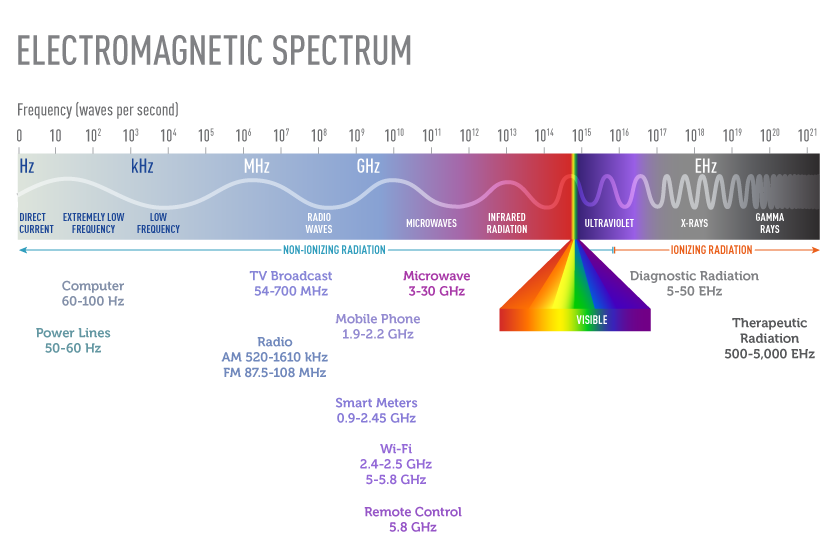
Electric and magnetic fields together are referred to as electromagnetic fields, or EMFs. The electric and magnetic forces in EMFs are caused by electromagnetic radiation. There are two main categories of EMFs:

  • Higher-frequency EMFs, which include x-rays and gamma rays. These EMFs are in the ionizing radiation part of the electromagnetic spectrum and can damage DNA or cells directly.
  • Low- to mid-frequency EMFs, which include static fields (electric or magnetic fields that do not vary with time), magnetic fields from electric power lines and appliances, radio waves, microwaves, infrared radiation, and visible light. These EMFs are in the non-ionizing radiation part of the electromagnetic spectrum and are not known to damage DNA or cells directly. Low- to mid-frequency EMFs include extremely low frequency EMFs (ELF-EMFs) and radiofrequency EMFs. ELF-EMFs have frequencies of up to 300 cycles per second, or hertz (Hz), and radiofrequency EMFs range from 3 kilohertz (3 kHz, or 3,000 Hz) to 300 gigahertz (300 GHz, or 300 billion Hz). Radiofrequency radiation is measured in watts per meter squared (W/m2).

The electromagnetic spectrum represents all of the possible frequencies of electromagnetic energy. It ranges from extremely long wavelengths (extremely low frequency exposures such as those from power lines) to extremely short wavelengths (x-rays and gamma rays) and includes both non-ionizing and ionizing radiation.


Selected References
  1. International Agency for Research on Cancer. Non-ionizing Radiation, Part 2: Radiofrequency Electromagnetic Fields. Lyon, France: IARC; 2013. IARC monographs on the evaluation of carcinogenic risks to humans, Volume 102.
  2. Ahlbom A, Green A, Kheifets L, et al. Epidemiology of health effects of radiofrequency exposure. Environmental Health Perspectives 2004; 112(17):1741–1754.[PubMed Abstract]
  3. International Commission on Non-Ionizing Radiation Protection. Guidelines for limiting exposure to time-varying electric and magnetic fields (1 Hz to 100 kHz). Health Physics 2010; 99(6):818-36. doi: 10.1097/HP.0b013e3181f06c86.

  4. Schüz J, Mann S. A discussion of potential exposure metrics for use in epidemiological studies on human exposure to radiowaves from mobile phone base stations. Journal of Exposure Analysis and Environmental Epidemiology 2000; 10(6 Pt 1):600-5.[PubMed Abstract]
  5. Viel JF, Clerc S, Barrera C, et al. Residential exposure to radiofrequency fields from mobile phone base stations, and broadcast transmitters: A population-based survey with personal meter. Occupational and Environmental Medicine 2009; 66(8):550-6.[PubMed Abstract]
  6. Foster KR, Moulder JE. Wi-Fi and health: review of current status of research. Health Physics 2013; 105(6):561-75.[PubMed Abstract]
  7. AGNIR. 2012. Health effects from radiofrequency electromagnetic fields. Report from the Independent Advisory Group on Non-Ionising Radiation. In Documents of the Health Protection Agency R, Chemical and Environmental Hazards. RCE 20, Health Protection Agency, UK (Ed.).

  8. Foster KR, Tell RA. Radiofrequency energy exposure from the Trilliant smart meter. Health Physics 2013; 105(2):177-86.[PubMed Abstract]
  9. Lagroye I, Percherancier Y, Juutilainen J, De Gannes FP, Veyret B. ELF magnetic fields: Animal studies, mechanisms of action. Progress in Biophysics and Molecular Biology 2011; 107(3):369-373.[PubMed Abstract]
  10. Boorman GA, McCormick DL, Findlay JC, et al. Chronic toxicity/oncogenicity evaluation of 60 Hz (power frequency) magnetic fields in F344/N rats. Toxicologic Pathology 1999; 27(3):267-78.[PubMed Abstract]
  11. McCormick DL, Boorman GA, Findlay JC, et al. Chronic toxicity/oncogenicity evaluation of 60 Hz (power frequency) magnetic fields in B6C3F1 mice. Toxicologic Pathology 1999;2 7(3):279-85.[PubMed Abstract]
  12. World Health Organization, International Agency for Research on Cancer. Non-ionizing radiation, Part 1: Static and extremely low-frequency (ELF) electric and magnetic fields. IARC Monographs on the Evaluation of Carcinogenic Risks to Humans 2002; 80:1-395.
  13. Ahlbom IC, Cardis E, Green A, et al. Review of the epidemiologic literature on EMF and Health. Environmental Health Perspectives 2001; 109 Suppl 6:911-933.[PubMed Abstract]
  14. Schüz J. Exposure to extremely low-frequency magnetic fields and the risk of childhood cancer: Update of the epidemiological evidence. Progress in Biophysics and Molecular Biology 2011; 107(3):339-342.[PubMed Abstract]
  15. Wertheimer N, Leeper E. Electrical wiring configurations and childhood cancer. American Journal of Epidemiology 1979; 109(3):273-284.[PubMed Abstract]
  16. Kleinerman RA, Kaune WT, Hatch EE, et al. Are children living near high-voltage power lines at increased risk of acute lymphoblastic leukemia? American Journal of Epidemiology 2000; 151(5):512-515.[PubMed Abstract]
  17. Kroll ME, Swanson J, Vincent TJ, Draper GJ. Childhood cancer and magnetic fields from high-voltage power lines in England and Wales: A case–control study. British Journal of Cancer 2010; 103(7):1122-1127.[PubMed Abstract]
  18. Wünsch-Filho V, Pelissari DM, Barbieri FE, et al. Exposure to magnetic fields and childhood acute lymphocytic leukemia in São Paulo, Brazil. Cancer Epidemiology 2011; 35(6):534-539.[PubMed Abstract]
  19. Sermage-Faure C, Demoury C, Rudant J, et al. Childhood leukaemia close to high-voltage power lines–the Geocap study, 2002-2007. British Journal of Cancer 2013; 108(9):1899-1906.[PubMed Abstract]
  20. Kabuto M, Nitta H, Yamamoto S, et al. Childhood leukemia and magnetic fields in Japan: A case–control study of childhood leukemia and residential power-frequency magnetic fields in Japan. International Journal of Cancer 2006; 119(3):643-650.[PubMed Abstract]
  21. Linet MS, Hatch EE, Kleinerman RA, et al. Residential exposure to magnetic fields and acute lymphoblastic leukemia in children. New England Journal of Medicine 1997; 337(1):1-7.[PubMed Abstract]
  22. Kheifets L, Ahlbom A, Crespi CM, et al. A pooled analysis of extremely low-frequency magnetic fields and childhood brain tumors. American Journal of Epidemiology 2010; 172(7):752-761.[PubMed Abstract]
  23. Mezei G, Gadallah M, Kheifets L. Residential magnetic field exposure and childhood brain cancer: A meta-analysis. Epidemiology 2008; 19(3):424-430.[PubMed Abstract]
  24. Does M, Scélo G, Metayer C, et al. Exposure to electrical contact currents and the risk of childhood leukemia. Radiation Research 2011; 175(3):390-396.[PubMed Abstract]
  25. Ahlbom A, Day N, Feychting M, et al. A pooled analysis of magnetic fields and childhood leukaemia. British Journal of Cancer 2000; 83(5):692-698.[PubMed Abstract]
  26. Greenland S, Sheppard AR, Kaune WT, Poole C, Kelsh MA. A pooled analysis of magnetic fields, wire codes, and childhood leukemia. Childhood Leukemia-EMF Study Group. Epidemiology 2000; 11(6):624-634.[PubMed Abstract]
  27. Kheifets L, Ahlbom A, Crespi CM, et al. Pooled analysis of recent studies on magnetic fields and childhood leukaemia. British Journal of Cancer 2010; 103(7):1128-1135.[PubMed Abstract]
  28. Hatch EE, Linet MS, Kleinerman RA, et al. Association between childhood acute lymphoblastic leukemia and use of electrical appliances during pregnancy and childhood. Epidemiology 1998; 9(3):234-245.[PubMed Abstract]
  29. Findlay RP, Dimbylow PJ. SAR in a child voxel phantom from exposure to wireless computer networks (Wi-Fi). Physics in Medicine and Biology 2010; 55(15):N405-11.[PubMed Abstract]
  30. Peyman A, Khalid M, Calderon C, et al. Assessment of exposure to electromagnetic fields from wireless computer networks (wi-fi) in schools; results of laboratory measurements. Health Physics 2011; 100(6):594-612.[PubMed Abstract]
  31. Public Health England. Wireless networks (wi-fi): radio waves and health. Guidance. Published November 1, 2013. Available at https://www.gov.uk/government/publications/wireless-networks-wi-fi-radio-waves-and-health/wi-fi-radio-waves-and-health. (accessed March 4, 2016)
  32. Ha M, Im H, Lee M, et al. Radio-frequency radiation exposure from AM radio transmitters and childhood leukemia and brain cancer. American Journal of Epidemiology 2007; 166(3):270-9.[PubMed Abstract]
  33. Merzenich H, Schmiedel S, Bennack S, et al. Childhood leukemia in relation to radio frequency electromagnetic fields in the vicinity of TV and radio broadcast transmitters. American Journal of Epidemiology 2008; 168(10):1169-78.[PubMed Abstract]
  34. Elliott P, Toledano MB, Bennett J, et al. Mobile phone base stations and early childhood cancers: case-control study. British Medical Journal 2010; 340:c3077. doi: 10.1136/bmj.c3077.[PubMed Abstract]
  35. Infante-Rivard C, Deadman JE. Maternal occupational exposure to extremely low frequency magnetic fields during pregnancy and childhood leukemia. Epidemiology 2003; 14(4):437-441.[PubMed Abstract]
  36. Hug K, Grize L, Seidler A, Kaatsch P, Schüz J. Parental occupational exposure to extremely low frequency magnetic fields and childhood cancer: A German case–control study. American Journal of Epidemiology 2010; 171(1):27-35.[PubMed Abstract]
  37. Svendsen AL, Weihkopf T, Kaatsch P, Schüz J. Exposure to magnetic fields and survival after diagnosis of childhood leukemia: A German cohort study. Cancer Epidemiology, Biomarkers & Prevention 2007; 16(6):1167-1171.[PubMed Abstract]
  38. Foliart DE, Pollock BH, Mezei G, et al. Magnetic field exposure and long-term survival among children with leukaemia. British Journal of Cancer 2006; 94(1):161-164.[PubMed Abstract]
  39. Foliart DE, Mezei G, Iriye R, et al. Magnetic field exposure and prognostic factors in childhood leukemia. Bioelectromagnetics 2007; 28(1):69-71.[PubMed Abstract]
  40. Schüz J, Grell K, Kinsey S, et al. Extremely low-frequency magnetic fields and survival from childhood acute lymphoblastic leukemia: An international follow-up study. Blood Cancer Journal 2012; 2:e98.[PubMed Abstract]
  41. Schoenfeld ER, O’Leary ES, Henderson K, et al. Electromagnetic fields and breast cancer on Long Island: A case–control study. American Journal of Epidemiology 2003; 158(1):47-58.[PubMed Abstract]
  42. London SJ, Pogoda JM, Hwang KL, et al. Residential magnetic field exposure and breast cancer risk: A nested case–control study from a multiethnic cohort in Los Angeles County, California. American Journal of Epidemiology 2003; 158(10):969-980.[PubMed Abstract]
  43. Davis S, Mirick DK, Stevens RG. Residential magnetic fields and the risk of breast cancer. American Journal of Epidemiology 2002; 155(5):446-454.[PubMed Abstract]
  44. Kabat GC, O’Leary ES, Schoenfeld ER, et al. Electric blanket use and breast cancer on Long Island. Epidemiology 2003; 14(5):514-520.[PubMed Abstract]
  45. Kliukiene J, Tynes T, Andersen A. Residential and occupational exposures to 50-Hz magnetic fields and breast cancer in women: A population-based study. American Journal of Epidemiology 2004; 159(9):852-861.[PubMed Abstract]
  46. Tynes T, Haldorsen T. Residential and occupational exposure to 50 Hz magnetic fields and hematological cancers in Norway. Cancer Causes & Control 2003; 14(8):715-720.[PubMed Abstract]
  47. Labrèche F, Goldberg MS, Valois MF, et al. Occupational exposures to extremely low frequency magnetic fields and postmenopausal breast cancer. American Journal of Industrial Medicine 2003; 44(6):643-652.[PubMed Abstract]
  48. Willett EV, McKinney PA, Fear NT, Cartwright RA, Roman E. Occupational exposure to electromagnetic fields and acute leukaemia: Analysis of a case-control study. Occupational and Environmental Medicine 2003; 60(8):577-583.[PubMed Abstract]
  49. Coble JB, Dosemeci M, Stewart PA, et al. Occupational exposure to magnetic fields and the risk of brain tumors. Neuro-Oncology 2009; 11(3):242-249.[PubMed Abstract]
  50. Li W, Ray RM, Thomas DB, et al. Occupational exposure to magnetic fields and breast cancer among women textile workers in Shanghai, China. American Journal of Epidemiology 2013; 178(7):1038-1045.[PubMed Abstract]
  51. Groves FD, Page WF, Gridley G, et al. Cancer in Korean war navy technicians: mortality survey after 40 years. American Journal of Epidemiology 2002; 155(9):810-8.[PubMed Abstract]
  52. Grayson JK. Radiation exposure, socioeconomic status, and brain tumor risk in the U.S. Air Force: a nested case-control study. American Journal of Epidemiology 1996; 143(5):480-486.[PubMed Abstract]
  53. Thomas TL, Stolley PD, Stemhagen A, et al. Brain tumor mortality risk among men with electrical and electronics jobs: a case-control study. Journal of the National Cancer Institute 1987; 79(2): 233-238.[PubMed Abstract]
  54. Armstrong B, Thériault G, Guénel P, et al. Association between exposure to pulsed electromagnetic fields and cancer in electric utility workers in Quebec, Canada, and France. American Journal of Epidemiology 1994; 140(9):805-820.[PubMed Abstract]
  55. Morgan RW, Kelsh MA, Zhao K, et al. Radiofrequency exposure and mortality from cancer of the brain and lymphatic/hemaopoietic systems. Epidemiology 2000: 11(12):118-127.[PubMed Abstract]
  56. SCENIHR. 2015. Scientific Committee on Emerging and Newly Identified Health Risks: Potential health effects of exposure to electromagnetic fields (EMF): http://ec.europa.eu/health/scientific_committees/emerging/docs/scenihr_o_041.pdf, accessed August 15, 2015.
  • Updated: May 27, 2016

Most text on the National Cancer Institute website may be reproduced or reused freely. The National Cancer Institute should be credited as the source and a link to this page included, e.g., “Electromagnetic Fields and Cancer was originally published by the National Cancer Institute.”

Please note that blog posts that are written by individuals from outside the government may be owned by the writer, and graphics may be owned by their creator. In such cases, it is necessary to contact the writer, artists, or publisher to obtain permission for reuse.

Are Electric And Magnetic Fields Separate Things, Crossed Uniform Electric And Magnetic Fields, Electric And Magnetic Field Amplitude, Electric And Magnetic Field Calculation, Electric And Magnetic Field Calculations With Finite-element Methods, Electric And Magnetic Field Cannot Accelerate, Electric And Magnetic Field Components, Electric And Magnetic Field Components Of An Electromagnetic Wave, Electric And Magnetic Field Of A Moving Charge, Electric And Magnetic Field Of Dipole Antenna, Electric And Magnetic Field Of The Heart, Electric And Magnetic Field Sensors, Electric And Magnetic Field Shielding, Electric And Magnetic Field Similarities, Electric And Magnetic Field Simulator, Electric And Magnetic Field Strength, Electric And Magnetic Field Theory, Electric And Magnetic Field Transformation, Electric And Magnetic Field Transmission

Read More

Top Story: Cellphones linked to cancer through shocking new study

I’ve gotten the question here on the show for years. And it’s natural to wonder about it. When you put your phone against your head, is the radiation that’s emitted doing physical harm to your body?

It begged the question no one wanted to ask or know the answer to, will using your phone give you cancer?

Read More

Quitting Smoking Is Easier Than Avoiding EMF Radiation

How much more proof do we need that being online isn’t healthy for us?

The latest terrible tech research is from Kaiser Permanente, published last week in the journal Scientific Reports. In a study of hundreds of pregnant women in the Bay Area, the authors found that those who were more exposed to the kind of radiation produced by cell phones, wireless networks and power lines were nearly three times as likely to suffer miscarriages.

It goes without saying that these electromagnetic fields, or EMFs, are around every single one of us. Thanks to our insatiable demand for social media, GPS and “smart” physical devices, there will be more and more of them every year.

I was a bit surprised by the Kaiser study’s publication.

Not because I doubt its findings — it seems sensible to assume that if radiation is powerful enough to transmit data through the ether, it’s probably powerful enough to scramble our cells as well.

Plus, I live in the Bay Area.

People who don’t live here think this place is nothing more than a magnet for any and every whiz-bang tech idea.

Those of us who actually live here know that there’s a counterveiling force of skepticism to meet every single one of those ideas.

That’s why Instacart will never replace Berkeley Bowl. It’s also why San Francisco and Berkeley — cities that are awfully friendly to technology in other ways — both passed laws requiring cell phone retailers to post warning signs about radiation, citing concerns about cancer, brain tumors and reproductive health.

But there will be tremendous pushback against any research showing how dangerous this stuff may be.

An example: San Francisco’s radiation-warning law, championed by then-Mayor Gavin Newsom, passed in 2010. But after a lawsuit from the cell phone industry, the city backed off on implementing it.

Around the same time, the California Department of Public Health drew up its set of guidelines to inform the public about the risks associated with cell phone use.

The health department then sat on these guidelines — for seven years — until The Chronicle told the state it was going to publish a news story about the case, and a judge signaled that she would order them to be released.

The reason for the delay?

The health department’s lawyers claimed the agency isn’t required to warn the public of health risks that haven’t been proved (despite the fact that the information was gathered by the agency’s own scientists). The lawyers also argued that releasing the guidelines might cause the public to panic.

Well, it might be time to start panicking. More and more, it sounds like the long-term effects of our Internet habits could be dangerous, not just for our relationships and our ability to focus, but our brains and bodies as well.

To this member of the public, the small-but-growing body of EMF research looks like anti-tobacco research must have looked in the 1950s — necessary and important work that will surely gain researchers an ugly, uphill battle against better-funded opponents.

Even more disconcerting?

Once scientists knew how dangerous tobacco was, the public could clearly and simply understand how to prevent those dangers: stop smoking.

But I’m not sure there’s any way to turn back the clock on EMFs.

I read the story about Kaiser’s new study on my cell phone, traveling between my office (which is replete with Wi-Fi networks) and my home (same). I happened to be traveling on BART, so when I put my phone down I studied the passengers around me.

Every sitting passenger was hunched over their phone, as if in prayer. The strap-hangers held their phones in front of their faces; the blue screens glided through the air like fish in an aquarium. All of this was normal, if vaguely depressing; a pageant I see and participate in every day.

But I also noticed, as if for the first time, how many people were wearing wireless Airpods and other earbuds. They wore them with a certain pride of ownership, as if they were in on a secret the rest of us were yet to learn.

I watched them, and thought about the public health guidelines that went unreleased for seven years. I thought about how the guidelines suggested removing headsets as soon as calls are over, and keeping the phone away from your body.

I thought about how many recent cell phone “improvements” chip away at that guidance. Then I lifted my phone from my lap and dropped it in my bag, out of sight.

Caille Millner is a San Francisco Chronicle staff writer. Email: cmillner@sfchronicle.com Twitter: @caillemillner

Read More

Test Lets You Know If Your Microwave Has a Radiation Leak

Want to know if your microwave oven leaks radiation? Physics Girl has
developed a pretty simple test to find out.

Have you ever wondered if your microwave oven leaks radiation? If so, it turns out there is a pretty simple test to check the radiation ‘seal’ on your microwave oven. We all want to make sure we are not exposed to the rays that turn frozen foods into ready-to-eat meals in minutes.

In fact, the process of ‘cooking’ foods in a microwave oven is pretty interesting. Microwaves ‘excite’ the water molecules within the food to cause it to rapidly heat up.

As you would expect, this radiation can’t be allowed to bathe your kitchen when in operation. Devices like microwave ovens must go through rigorous testing before they can be released for general use. Let’s join Physics Girl as she tests whether some microwaves can, in fact, leak radiation.

The radiation test

A fascinating, if not slightly disconcerting video by Physics Girl shows us we should probably check our microwave ovens. Her simple experiment shows us that there is an easy and effective way to check the integrity of the radiation shielding on your kitchen appliance.

Microwave ovens, like cell phones, emit radiation in a specific band of EM frequencies. So you might expect that by placing your phone inside a microwave and closing the door the signal would be blocked by the microwave shell. It would also be reasonable to assume that you shouldn’t be able to ring the phone once inside. But Physics Girl’s test shows that with some microwave ovens you can! This was surprising, to say the least.

Faraday cages are supposed to ‘shield’ anything inside them from external electromagnetic fields, like electricity. They work when an electric field or other electromagnetic waves, like those from cellular phones, cause electrons in the metal to move and create an electric field to exactly oppose and cancel out the external wave or field.

 They hypothesized that the radiation could be exploiting ‘holes‘ in the shielding of the door allowing the microwave oven to leak radiation. As Physics Girl points out, her experiments show that some microwaves do let the specific frequencies of mobile phones through, providing clear evidence that some form of radiation leakage is possible within these appliances.

Physics Girl does note that her experiment had a very small sample size, did not take into consideration the microwave oven’s age or the proximity of it to a cellular tower. These variables could affect the results.

Should you be worried?

FDA regulations actually allow for a small amount of leakage from microwaves, about 5 mW/cm2. The radiation itself is non-ionising so won’t damage your DNA directly, rather it will excite the water within your soft tissues.

The FDA does warn that high exposure to microwaves can lead to a painful burn. Organs like eyes and testes are particularly vulnerable because they have relatively little blood flow to carry away the heat. Also, the lens of the human eye is very sensitive to heat. High levels of microwaves could cause cataracts.

The FDA does note that this kind of damage would require a large amount of radiation.

 So should you be concerned if you microwave oven leaks radiation? Well no. You are more likely to hurt yourself from a heated glass of water than the radiation itself. The radiation will not be in a high enough dose to cause you any harm.

Convection Microwave Oven Health, Microwave Oven And Health Care Caution, Microwave Oven Dangers Snopes, Microwave Oven Dangers Studies, Microwave Oven Dangers To Health, Microwave Oven Emits Radiation, Microwave Oven Harmful To Health, Microwave Oven Health And Safety, Microwave Oven Health Dangers, Microwave Oven Health Issues, Microwave Oven Health Safety, Microwave Oven Impact On Health, Microwave Oven Ionizing Radiation, Microwave Oven Is Dangerous For Health, Microwave Oven Radiation Effects On Food, Microwave Oven Radiation Effects On Human Body, Microwave Oven Radiation Shield, Microwave Oven Radiation Source, Microwave Oven Radiation Testing, Microwave Oven Repair Dangers

Read More

Electromagnetic Fields Linked to Health Risks

Exposure of pregnant women to non-ionizing radiation from magnetic fields significantly raises the risk of miscarriage, says a new study from Kaiser Permanente. The study raises the question of the danger of exposure to electromagnetic fields in the general population.

Non-ionizing radiation from magnetic fields is produced when electric devices are in use and electricity is flowing. It is ubiquitous in modern life, because it can be generated by commonly used devices, including electric appliances, power lines and transformers, wireless devices and wireless networks.

Humans are exposed to magnetic fields when they are in close proximity to these sources while they are in use.

The health hazards from ionizing radiation — the type of radiation most people think of when they think of radiation — are well-established, and they include radiation sickness, cancer and genetic damage.

However, the evidence of health risks to humans from non-ionizing radiation remains limited, said study leader Dr. De-Kun Li, a reproductive and perinatal epidemiologist at the Kaiser Permanente Division of Research in Oakland, California.

“Few studies have been able to accurately measure exposure to magnetic field non-ionizing radiation,” said Li. “In addition, due to the current lack of research on this subject, we don’t know the biological threshold beyond which problems may develop, and we also don’t yet understand the possible mechanisms for increased risks.

For Li’s study, women with confirmed pregnancies wore a small (a bit larger than a deck of cards) magnetic-field monitoring device for 24 hours. Participants also kept a diary of their activities on that day, and were interviewed in person to better understand how typical their activities were on the day they were monitored.

Researchers controlled for multiple variables known to influence the risk of miscarriage, including nausea/vomiting, past history of miscarriage, alcohol use, caffeine intake, and maternal fever and infections.

The women were divided into four groups of exposure — from lowest to highest.

The researchers found that miscarriage occurred in 10.4 percent of the women who were exposed to the lowest levels of electromagnetic fields, and 24.2 percent in women exposed to higher levels. The rate of miscarriage in the general population is between 10 and 15 percent. The increase was almost threefold, said Li.

“This study provides evidence from a human population that magnetic field non-ionizing radiation could have adverse biological impacts on human health,” he said.

“We hope that the finding from this study will stimulate much-needed additional studies into the potential environmental hazards to human health.”

The study was published in the journal Scientific Reports.

An earlier study published in Reproductive BioMedicine, found that men who talk on a cellphone for at least an hour every day double their risk of infertility. Researchers found that men who talked on their cellphones for more than an hour a day had a 60.9 percent chance of having abnormal sperm counts compared to 35.7 percent of the general population. Men who talked on their phones while they were charging had an even higher risk — 66 percent.

© 2018 NewsmaxHealth. All rights reserved.

Read More

Electric blankets increase risk of miscarriage: study

Electric blankets warm you in winter and save on your power bills. Are they safe, too? Unfortunately no, a recent study says, especially if you are pregnant.

Electric blankets and many other environmental sources such as power lines, wireless devices and networks generate extremely low frequency (ELF) electromagnetic fields, called non-ionizing radiation.

High exposure to non-ionizing radiation significantly raises the risk of miscarriage, according to the study by Kaiser Permanente published in Nature last week.

The study examined the effect of non-ionizing radiation from magnetic fields on 913 pregnant women by asking them to wear a small magnetic-field (MF) monitoring device while recording their regular activities for a day.

After controlling for other factors, researchers examined the rate of miscarriages after classifying participants into either a “low” or “high” non-ionizing radiation exposure level, with the “low” group comprising of women who faced less than 2.5 mG of exposure.

Results showed women in the higher exposure group had more than double the risk of miscarriage than women in the low group. About 24 percent miscarried in the higher exposure group while 10 percent did in the other, the study showed.

The miscarriage rate in the higher exposure group was also higher than the rate of the general population, which is around 10 to 15 percent.

“The study provides additional evidence that exposure to high MF levels in pregnancy is associated with increased risk of miscarriage. Four other studies published during the past 15 years that examined the relationship between high MF exposure and the risk of miscarriage also support this finding,” it said.

The World Health Organization (WHO), however, says evidence does not confirm exposure to low-level electromagnetic fields has any adverse health consequences although it noted the need for further research.

“The overall weight of evidence shows that exposure to [magnetic] fields at typical environmental levels does not increase the risk of any adverse outcome such as spontaneous abortions, malformations, low birth weight, and congenital diseases,” it said.

Although no definitive correlation between ELF and adverse health effects has been found, research has confirmed that electric blankets can emit high levels of radiation depending on the heating intensity.

A 2012 survey from Korea’s Ministry of Environment showed electric blankets could emit high levels of ELF. The ministry found that raising the heating intensity of electric blankets spikes emissions three-fold.

The survey on seven types of electric blankets sold in the market showed electromagnetic waves peaked at 71.1 milliGauss when the heating intensity was set to high compared to 23.3 mG at low.

Data also showed a 10-centimeter distance from the electric blanket slashed electromagnetic waves by 90 percent, the ministry said.

The ministry cautioned against using electric blankets at a high-intensity level while noting that electric blankets approved by the National Radio Research Agency and the Korea Testing Certification carry distinctive stamps.

yjc@docdocdoc.co.kr

<© Korea Biomedical Review, All rights reserved.>

Read More