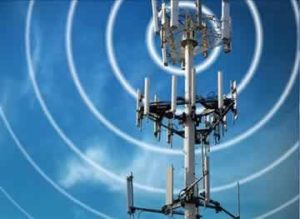
Cell towers blanket the globe. The United States is home to more than 300,00 cell sites. They appear innocent. But are they?
Cell towers are the base stations that control mobile phone communication. They may or may not be clearly visible in your neighborhood. Sometimes they are disguised as cacti, trees, or even flags.
Because we can’t see, feel or smell the electromagnetic radiation coming from a cell tower (or cell site which includes towers, antenna masts and other base station forms), it’s hard to believe there is any potential for harm.
In fact, the Federal Communications Commission, our government’s regulating agency, has made sure health concerns aren’t addressed when cell tower applications are considered. According to the Telecommunications Act of 1996,
In 2003, R. Santini, et al in Rennes, France conducted a study in which they found that people living within 300 meters of cell antennas reported the following disorders: “fatigue, sleep disturbances, headaches, difficulty concentrating, depression, memory loss, visual disruptions, irritability, hearing disruptions, skin problems, cardiovascular disorder and dizziness.
In the same year, E.A. Navarro in Valencia, Spain conducted a study in which he concluded that “exposed individuals that lived within 50-150 meters of the base station…experience more headaches, sleep disturbances, irritability, difficulty concentration, appetite loss and dizziness”.
In 2007, British researcher, Dr. John Walker compiled a series of cluster studies on the effects of cell tower radiation. Studies showed high incidences of cancer, brain hemorrhages and high blood pressure within a radius of 400 yards of mobile phone masts.
Studies That Demonstrate a Health Risk
The World Health Organization officially classifies electromagnetic radiation a possible 2B carcinogen. (The same category as lead, DDT, and styrene.)
The following studies suggest short-term and long-term health risks within 300-400 meters of a cell tower. (Less than three-tenths of a mile)
This is a compelling survey of 270 men and 260 women showing changes in symptoms in relation to cell tower proximity. Note the decrease in reported headaches the further from the cell site.
Cell Phone Tower Health And Safety, Cell Phone Tower Health Risks India, Cell Phone Towers Health Canada, Cell Tower And Health Risks, Cell Tower Dangers To Health, Cell Tower Effects On Health, Cell Tower Health Concerns, Cell Tower Health Effects, Cell Tower Health Issues, Cell Tower Health Risks, Cell Tower Health Risks 2015, Cell Tower Health Studies, Do Cell Towers Affect Health, Effect Of Cellphone Towers On Health
A study of real-world exposure to non-ionizing radiation from magnetic fields in pregnant women found a significantly higher rate of miscarriage, providing new evidence regarding their potential health risks. The Kaiser Permanente study was published today in the journal Scientific Reports (Nature Publishing Group).
Non-ionizing radiation from magnetic fields is produced when electric devices are in use and electricity is flowing. It can be generated by a number of environmental sources, including electric appliances, power lines and transformers, wireless devices and wireless networks. Humans are exposed to magnetic fields via close proximity to these sources while they are in use.
While the health hazards from ionizing radiation are well-established and include radiation sickness, cancer and genetic damage, the evidence of health risks to humans from non-ionizing radiation remains limited, said De-Kun Li, MD, PhD, principal investigator of the study and a reproductive and perinatal epidemiologist at the Kaiser Permanente Division of Research in Oakland, California.
“Few studies have been able to accurately measure exposure to magnetic field non-ionizing radiation,” Dr. Li said. “In addition, due to the current lack of research on this subject, we don’t know the biological threshold beyond which problems may develop, and we also don’t yet understand the possible mechanisms for increased risks.”
In a new study funded by the National Institute of Environmental Health Sciences, researchers asked women over age 18 with confirmed pregnancies to wear a small (a bit larger than a deck of cards) magnetic-field monitoring device for 24 hours. Participants also kept a diary of their activities on that day, and were interviewed in person to better control for possible confounding factors, as well as how typical their activities were on the monitoring day. Researchers controlled for multiple variables known to influence the risk of miscarriage, including nausea/vomiting, past history of miscarriage, alcohol use, caffeine intake, and maternal fever and infections.
Objective magnetic field measurements and pregnancy outcomes were obtained for 913 pregnant women, all members of Kaiser Permanente Northern California. Miscarriage occurred in 10.4 percent of the women with the lowest measured exposure level (1st quartile) of magnetic field non-ionizing radiation on a typical day, and in 24.2 percent of the women with the higher measured exposure level (2nd, 3rd and 4th quartiles), a nearly three times higher relative risk. The rate of miscarriage reported in the general population is between 10 and 15 percent, Dr. Li said.
“This study provides evidence from a human population that magnetic field non-ionizing radiation could have adverse biological impacts on human health,” he said.
Strengths of this study, Dr. Li noted, included that researchers used an objective measuring device and studied a short-term outcome (miscarriage) rather than one that will occur years or decades later, such as cancer or autoimmune diseases. The study’s main limitation is that it was not feasible for researchers to ask participants to carry the measuring device throughout pregnancy.
Dr. Li noted that the potential health risk of magnetic-field non-ionizing radiation needs more research. “We hope that the finding from this study will stimulate much-needed additional studies into the potential environmental hazards to human health, including the health of pregnant women.”
Earth’s Magnetic Field And Health, Electromagnetic Fields And Health, Electromagnetic Fields Health Risk, Health And Safety Magnetic Fields, Health Canada Magnetic Fields, Health Concerns Magnetic Fields, Health Hazards Of Magnetic Fields, Health Issues Magnetic Fields, Magnetic Field Effects On Health, Magnetic Field Exposure Health, Magnetic Field Health And Safety, Magnetic Field Health Concerns, Magnetic Field Health Issues, Magnetic Field Impact On Health, Magnetic Field On Health, Magnetic Field Strength And Health, Magnetic Field Strength Health, Magnetic Fields And Health Effects, Magnetic Fields And Health Issues, Magnetic Fields And Health Risks, Magnetic Fields Bad For Health, Magnetic Fields Health Benefits, Magnetic Fields Health Effects, Magnetic Fields Health Problems, Magnetic Fields Health Risk, Static Magnetic Field Health Effects, Static Magnetic Fields Health, Strong Magnetic Fields Health
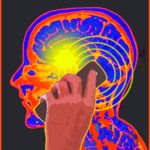
Davis explains that we know MW radiation effects do not follow the doses-effects response model; increasing the dose does not mean an increase response or effect follows. She thinks effects have more to do with the characteristics of the signal, which is erratic, and with chronic exposure. In her view, cell phone radiation disrupts “resonance” and “interferes” with body functions, such as DNA repair. Research needs to consider this if we are to have answers, she says. We know that MW radiation disrupts/relaxes the brain-blood barrier, which plays a crucial role in protecting our brains from substances that are in the blood and can be damaging or toxic. The brain-blood barrier develops as we grow. If we introduce a blue dye in the blood of an animal, its entire body will go blue but its brain will remain pink. Cell phone radiation relaxes this barrier reason why is used now to enhance the uptake of drugs into the brain, for instance to treat a brain tumor with medications. We also know that cell phone radiation interferes with DNA repair. And, we know that it penetrates further into tissue that is not protected by bone or density -breasts, chest, gonads, which are more vulnerable to its effects. (11)
Davis believes that current regulations are lax. The standard to estimate radiation exposure -the “standard anthropomorphic male” or SAM is not representative of the population exposed to cell phone radiation. SAM was taken from the top 10% of military recruits in 1989 -a six-foot-three 220 pounds male with an 11-pound head. Most people in the world do not have SAM’s head and we know that radiation goes more deeply into smaller heads than larger ones, and we know that today, three out of every four 12-year-olds, and half of all ten-year-olds, have a cell phone. It is too risky to wait for more science when we already know enough to be concerned. We should change regulations to make it safer for cell phone users and we should inform people about the risks and what they can do to be safe. (5)
There is also a strong concern about pregnant women and their babies because of what is known already about animal studies. It may be legal for companies to show advertisements of phones being used in ways that are not recommended, Davis says, but it is not ethical. Selling phones to people, then telling them in fine print to not use them next to the body while in all advertisements they are shown using cell phones exactly next to the body, it is a serious disconnect, and people need to be aware of this. Some countries around the world, including France, have banned companies from advertising cell phones to children due to the possible risks. (10)
Cordless phones are an issue too; they are dangerous but most of us are unaware. The base station of cordless phones radiates all the time; when we hold the handset to our head we get a huge dose. About a third of our exposure to MW radiation comes from cordless phones. Davis recommends we do not use cordless phones, and if we do avoid having the base station close to our bed or in our bedroom. (6)
Davis understands that cell phones are not going away. Her point is about increasing safety for people using cell phones and for companies to consider the safety of users when they make them. Experimental studies show that good nutrition like “literally exposing animals or cells to the natural hormone melatonin or vitamins A, E, or C before you expose them to RF radiation—may help repair damage.” Good cell phone practices help. They include using a speaker-phone or a headset with the phone held a hand’s distance away, never keeping a phone turned on next to our body, or a wireless headset on in our ear or pocket, without turning off the phone. Also, we should use our phones only when signal quality is good, weaker signals boost MW radiation. And, we should text rather than talk on the phone, and teach our children to do the same. Tweens and teens, and the rest of us, should never sleep with cell phones on under our pillow or next to our beds. Pregnant women should keep their cell phones away from their abdomen; and, new mothers should protect babies from their phones. Men should keep their cell phones off when in their pockets; radiation affects their sperm quantity and quality. We should use a landline at home and avoid cordless phones too. We also need to do some political work and require warning labels about safety in using cell phones be applied to cell phones directly, not in manuals where nobody reads them. Also, cell phones should always include earpieces and speakerphones. And, major revisions of safety standards should be conducted, and specific recommendations should be made about lowering direct radiation to the head. Furthermore, a national survey of cell phone radiation exposure is needed, as well as monitoring of heavy cell phone users by creating access to cell phone billing records to qualified researchers, increasing the power of studies made. (5)
In 2015, Dr. Martin Blank (Department of Physiology and Cellular Biophysics, Columbia University) presented a letter signed by a scientists concerned with electromagnetic radiation and their effects on our health, particularly their impact on our DNA. Blank said:
“We are really all part of a large biological experiment, without our informed consent. To protect our children, ourselves, and our ecosystem, we must reduce exposure by establishing more protective guidelines. And so, today, scientists from around the world are submitting an Appeal to the United Nations, its member states and the World Health Organization, to provide leadership in dealing with this emerging public health crisis”. (12)
Cell phones may be here to stay; but, we can demand that they are safe. We, our children and grandchildren, deserve to be protected from the effects of cell phone radiation. We should challenge the callous disregard cell phone makers have shown for our health and well being. We know enough to make some needed changes, reducing exposure, and implementing appropriate safety guidelines. We know that corporations have vested interest and procrastinate addressing this issue, creating doubt about findings so things continue as they are. This has happened before with tobacco, asbestos, insecticides and so on. We are challenging a more than a trillion dollar global industry. Change never happened without struggle. To act we need to be informed, please be informed.
5. The truth about cell phone radiation, what the industry has done to hide it, and how to protect your family. Devra Davis, 2010. Dutton, Penguin Group, USA.
The two small words electromagnetic fields or EMF (or one small acronym depending on your direction of thought) describe something that is part of the root cause of many terrible things that are currently plaguing man at this point in time. The new and improved methods of protection from this terrible force that are constantly being invented for us are the only saving graces we have these days.
These electromagnetic fields are being created by the electricity all around us, especially by electric power lines that are a feature of our every day lives. There are ways we that we can minimize the effects that the EMF has on us, but alternatives are to invest in the protection devices that are available. The best option is to use the minimizing measures as well as the protection devices. The difference between a minimizing measure and the protection devices is that the devices are tested and have proven results while the alternate measures have evolved from household wisdom.
There are many different varieties of protection from EMF available these days. There are personal protection devices that are just for one person, there are cellular phone protection devices, devices to protect your entire home as well as many more. Each device is specifically designed to perform a certain type of protection. The use of more than one in collaboration would be recommended since this will enhance your level of protection.
Protection devices that are portable or personal will only provide protection or shielding to one person, the person wearing or carrying it. These are recommended for everyone, but especially those who are on the move a large portion of the time since they are not in a shielded environment a lot of the time, especially on the road. These EMF protection devices are either carried or worn on the person in order to be effective.
Cell phone radiation protection devices come in a variety of shapes, sizes and styles, but their purpose is the same, completely eradicate the entrance of EMF into the head. Some protection devices are designed to be applied to the backs of cellular phones and deflect EMF before they reach the head. Other devices are connected to the phone and act as a head set or hands free kit to put as much distance between the head and the phone that is emitting the fields. The utilization of both types of devices simultaneously would be recommended as the cellular phone emits large quantities of radiation.
Whole house protection devices can be utilized in homes of almost any size and they provide blanket coverage for all people within the home and as such are highly recommended, especially for families with children, for the overall coverage it provides. It is best to utilize the whole house protection device in conjunction with personal EMF protection devices for all the individuals in the home.
Ashland, MA — (SBWIRE) — 09/28/2015 — Based on its own review of the matter, the Ashland Public School District is reducing wireless radiation exposures to children by instituting district wide “best practices for mobile devices”. Spurred by parent Cecelia Doucette’s concerns about the lack of safety data on Wi-Fi and children, the district investigated the issue and developed a policy to substantially reduce wireless exposures to stud
US Public School Limits Wi-Fi
ents and staff. Doucette not only brought the issue to the district’s attention, but then also worked with state legislatures who introduced two bills concerning electromagnetic radiation this session. The Environmental Health Trust submitted written testimony on MA Senate Bill 1222 after expert scientists presented information on wireless health risks at a briefing at the Massachusetts State House in June 2015.
Since wireless devices are constantly emitting radiation even when the user is not using the Internet, the instruction to “turn it off when not in use ” stops the Wi-Fi antennas from continuously emitting radiation and is one simple way to reduce the radiation dose and exposure time for children and staff.
Instructions for “Best Practices” are posted in every classroom and include:
– Turn off the device when not in use
– Turn Wi-Fi on only when needed
– Always place the mobile device on a solid surface
– Viewing distance should be a minimum of 12 inches from the screen
– Specific product information guides are available through the IT department
– We ask that staff members regularly remind and instruct students in using best practices in regards to mobile devices
Ashland’s Best Practice of “keeping the device on a table” and no closer than a 12 inch viewing distance is critically important. Laptops and tablets have fine print warnings buried in their manuals specifically stating that the laptop should be at least 8 inches away from the user so that the user is not exposed to radiation levels that exceed as-tested FCC levels. If a device is used on a lap, as is common practice, the student could receive radiation levels far exceeding FCC limits. FCC limits are set to prevent the radiation from heating the brain and body but are not set to avoid chronic impacts on the developing nervous system or reproductive organs.
Many are unaware of FCC fine print advisories in the manuals of every wireless device confirming as-tested distances set to avoid heating. Cell phones, laptops and even baby monitors have these specific instructions in their product information guides. By referring to the product information guides, Ashland Public Schools are informing people about the need to keep a distance between the device and our bodies. As a public service, Environmental Health Trust (EHT) has compiled these fine print warnings on their website Showthefineprint.org.
It is important to note that even if users comply with these FCC recommended distances as stated in the device manual, accumulating research shows that biological damage can occur from wireless radiation levels far lower than these FCC levels. FCC limits are only set to protect people from heating harm and do not address non-thermal effects.
This ground breaking policy action by the Massachusetts school district is indicative of the wave of parents raising concerns about Wi-Fi across the country. Ashland, Massachusetts parent Cecelia Doucette wrote an article in Ashland Local Town Pages about these new best practices. Significant news and print media have picked the issue up after Massachusetts parents filed a lawsuit against a private boarding school alleging the school did not accommodate their 12-year-old child’s diagnosed debilitating sensitivity to the school’s WiFi system.
Ashland is the first US public school to create such policy on wireless transmitting devices. However, this US Massachusetts school district now joins dozens of schools and governments that have already implemented even more stringent measures to reduce wireless exposure to children. For example, Israel and France have banned Wi-Fi in kindergarten. The European Union recommends wired Internet rather than wireless in schools.
“Right To Know” efforts by local governments are also moving across the United States. A judge just upheld Berkeley’s new Cell Phone Right To Know Ordinance which requires cell phone sellers to tell customers about these FCC radio frequency radiation distances.
Suffolk County in New York voted to label wireless routers in all public buildings including schools. The US United Federation of Teachers Union now hosts a webpage on how to reduce exposures to protect pregnant women, other staff members and students.
The Environmental Health Trust maintains a regularly updated database of these worldwide precautionary policies on wireless related to children and schools.
About Environmental Health Trust
Environmental Health Trust (EHT) educates individuals, health professionals and communities about controllable environmental health risks and policy changes needed to reduce those risks. Currently EHT is raising health concerns about wireless in schools and recommending safer hardwired internet connection installations. The foundation’s website is the go-to place for clear, science-based information to prevent disease.
PINETOP-LAKESIDE — The Pinetop-Lakeside Board of Adjustment rejected an application Nov. 2 for a variance request by Verizon Wireless to build 94-foot tower on the corner of Woodland Lake Road and Julia Lane.
The site is located on the former Pico’s Nursery property, which is now operated as an wedding and event center.
Town Community Development Director Cody Blake offered introductory comments and said that Verizon’s interest in building a new tower was a “complaint-driven” response from local residents requests. The Board of Adjustment, at their Oct. 19, meeting also requested that the town assess the possibility of co-locating on a tower owned by White Mountain Communications. Verizon said the existing tower would not satisfy their needs, Blake said.
Fifteen residents lined up following Blake’s introductory comments to speak on the issue themselves. An overwhelming theme of most who testified Nov. 2 said they were mostly concerned with possible negative health effects, and property values dropping should the tower become a reality. Most said they didn’t want the tower in their residential neighborhood.
Although most everyone agreed that the wireless service is poor in the area, most said they didn’t want better service if it meant a potential risk to their health or a drop they would see in property values.
The first four speakers mentioned their health concerns for two autistic children who live within about 100 feet of the proposed location.
Don McMasters, who also lives near the proposed tower site, introduced himself as the president of the White Mountains Autism Foundation and said that living near a cell tower is extremely damaging to an autistic person. he also spoke to the general feeling against having the tower in a residential area.
“Everyone who would like to live within 400 feet of a cell tower, raise your hands,” he said. Very few hands went up.
“We have a son with autism who is 29 and we’ve been told not to live anywhere near high EMF (Electromagnetic fields).” Barb McMasters, Bob’s wife said.
McMasters gave members of the board an 18-page packet of materials about the health risks involving cell towers.
“Some say it’s a theory. Let me tell you, it’s not a theory, it’s real. Please dig into it. And by the way, there are six — and not two — individuals with autism living in this community,” he added
Chris Paxman, the father of two autistic children who lives across the street from the proposed tower site gave the most emotional presentation of the night.
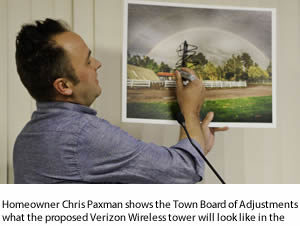
Paxman is a photographer, came to the lectern fighting back tears. He said his children were the two that everyone was talking about and that he would have a view of the new tower from his front window. Paxman produced photographs of his view of the Pico Greenhouse property with a rainbow, a photo of one son and an aerial view he took with a drone to show the board and the crowd what he was faced with.
“Let’s make this more realistic,” Paxman said as he took out a dark felt pen and drew the tower onto his photograph. “Oh, and let’s put those realistic branches they propose on it, too,” he said, referring to plans to make the tower look like an tree.
As he drew a rough-looking tower sketch on his photo, the impact of Paxman’s emotions seemed to grip the audience. He then produced a photo of one of his son said, “He can’t go anywhere, but he has the time of his life in the backyard. I am not really willing to risk myself or my kids for this.”
Merry Lee Cox, who lives nearby, has been a vocal opponent of the tower. She said it was a lack of communication about the tower that brought her to the meeting Oct. 19. She spoke of a possible 5 -20 percent drop in nearby property values as a result of the tower.
“We’re middle-class people and our homes are our equity,” she said, adding that tower fires can occur, causing catastrophic failure and referencing YouTube videos to confirm such incidents.
The property owners, Alison Stewart and John Samora, were the only ones to speak in favor of the tower. They said they couldn’t testify to the health concerns, but said it is a commercial property and they were going to try to make it blend in. They said they planned to make the facility as aesthetically pleasing to the neighborhood as possible by planting trees and shrubs to blend it into the trees. Stewart and Samora own the Greenhouse on Woodland, a wedding and event center located at the former Pico’s Nursery location.
In written comments the offered after the meeting, Samora said that he found some of the passionate comments made by people at the meeting “hypocritical.”
“I am willing to bet that most if not all of those speakers at the (town) council meeting…had cell phones in their pockets, which also emit waves. Further, there was a lot of talk about protecting our children from these waves, and yet, many of these same people send their children to the Blue Ridge School district where there are not one, but two cell towers on their campuses,” he wrote.
“You know EM radiation is everywhere. I mean, it’s just floating all around us these days,” Councilman James Snitzer said. “We used to be told that watching TV would give us radiation, then it was microwave ovens and now it’s cell phones and they’re everywhere, so they wouldn’t be around in my opinion, if that was true. I just don’t believe there’s a significant risk from cell phones.”{/div}
Councilor Kathy Dahnk said she would like to see Verizon research an area outside of a residential area. Others wondered why a Verizon representative was not there to answer questions.
Councilor Carla Bowen said she just didn’t think it was the right place. Then Dahnk made a motion to deny the variance, which was seconded by Bowen. The vote passed 6-1 to deny Verizon’s variance request, with Snitzer against the denial and Councilor Norris Dodd attending via teleconference.
Samora and Stewart spoke greeted many in the crowd following the meeting, and hugged Chris Paxman. Samora said he hoped the tower issue would not affect his relationships with all of his neighbors.
”With a few, certainly. But not, I hope, with most…we were looking at this as partially a public safety issue and an infrastructure issue as proposed,” he wrote.
If petitions are any indication, a growing number of Canadians are very concerned about being zapped by radiation from their cellphones, baby monitors and wireless internet routers.
Seven of the 16 environmental petitions submitted to the auditor general’s office between July 2016 and June 2017 “concerned potential adverse health effects on humans from radiofrequency electromagnetic radiation from personal wireless devices,” according to one of the fall reports from Canada’s environment commissioner, released Tuesday. That’s up from one in 2014-2015 and none in 2015-2016.
Several of the petitions express concern about how close people hold their cellphones to their bodies. One requests that Canada stop marketing wireless devices to children under 14. Another focuses on the possible impacts of radiation on the human eye and newborn babies. One asks that Statistics Canada collect data on electromagnetic hypersensitivity as part of its Canadian community health survey, while another wants the federal government to monitor radiofrequency and microwave radiation in schools.
The petitions were submitted by individuals and organizations in Ontario and Manitoba. One was filed by a group called Canadians for Safe Technology (C4ST), which claims on its website that “current assumptions about the safety of electromagnetic radiation are outdated and must be revised.”
On its website, Health Canada states that a growing number of people are reporting symptoms they attribute to electromagnetic fields (EMFs), including headaches, fatigue, nausea and skin redness. But according to the department, “there is no scientific evidence that the symptoms attributed to EHS (electromagnetic hypersensitivity) are actually caused by exposure to EMFs.”
According to the World Health Organization’s website, ‘no adverse health effects from low level, long-exposure to radiofrequency or power frequency fields have been confirmed.’
The true cause of the symptoms is “unclear,” Health Canada says, but could be related to fluorescent lights or glare from computer monitors.
The petitioners all take aim at Canada’s Safety Code 6, Health Canada’s radiofrequency human exposure guidelines, many suggesting the guidelines aren’t stringent enough.
Health Canada says Safety Code 6 guidelines are based on hundreds of peer-reviewed studies and are “set far below the lowest level of RF (radiofrequency) exposure that could produce potentially harmful effects in humans.” The code was most recently updated in 2015.
According to the World Health Organization’s website, “no adverse health effects from low level, long-exposure to radiofrequency or power frequency fields have been confirmed,” though research continues. Studies to date have not shown a link between normal exposure to radiofrequency radiation and increased risk of cataracts, cancer or pregnancy problems.
In June 2015, the House of Commons health committee issued a report recommending that the government further study electromagnetic hypersensitivity and a possible connection between wireless device use and cancer. In response, the government promised to keep studying the international scientific literature.
But that’s not good enough, argue the petitioners. According to the environment commissioner’s report, one petition “asks the (health) minister to produce the scientific findings that Health Canada used to support Safety Code 6.”
Unlike other government petitions, environmental petitions don’t need multiple signatures. They are submitted to the environment commissioner, who obtains answers from relevant federal ministers. None of these seven petitions have yet received a response.
In contrast, public petitions presented in the House of Commons require the support of at least five Canadians and must be sponsored by a member of Parliament.
Recent public petitions include requests that the government ban shock collars on pets (5,421 signatures), that curling be declared a national sport (3,659 signatures) and that Parliament pass a law giving employees the legal right to ignore work emails outside working hours (79 signatures).
Calif. Gov. Jerry Brown yesterday, after about a month’s wait, vetoed Senate Bill 649 that would have removed local control over cellphone tower creation.
It would have created a state mandated system of cell towers every couple of hundred feet apart in California, said opponents.
Opposing it were 300 cities, 47 counties and more than 100 community, planning, health, environment and justice organizations.
EMF Safety Network and Ecological Options Network opposed SB 649 since the bill was introduced in March because it said cell towers emit harmful radiation. The bill would have allowed unlimited refrigerator-size cell equipment on utility poles, streetlights, sidewalks, in parks, on schools and public buildings with no safety oversight.
Sandi Maurer, Director of EMF Safety Network said, “We mailed Governor Brown a couple thousand postcards depicting SB 649 as a slobbering warty monster wielding a zapping cell tower and asked him to veto SB 649. We are thrilled and relieved Governor Brown vetoed this bill.”
Mary Beth Brangan co-director of EON said, “Now we need to prepare ourselves for the next state and federal telecom push, where they will try again with bills to overtake local authority and disregard public health.”
Gov. Brown said local communities should have a say in placement of any such towers.
Cellular Industry Backed Bill
The bill was primarily supported by the Cellular Telecommunications and Internet Association, the main trade group for the U.S. wireless telecommunications industry. The group said SB 649 would help boost the economy.
Yet the bill had alarmed many local government officials around the state. They worried if SB 649 became law, it would cap how much they could charge phone companies for leases to $250 a year. Activists, meanwhile, were concerned about the risk to public health from cell towers.
“I am thrilled that Governor Brown showed strength and stood up to this powerful wireless industry and said no — you are not going to do this in my state!” Ellen Marks, a San Francisco-based leader of the California Alliance for Safer Technology, wrote in an email after Brown’s decision was posted online.
“This is a tremendous victory for democracy,” said Marks, whose group is trying to keep cellular antennas away from homes, schools, offices and parks.
A CTIA spokeswoman said the bill maintained local authority for “small cell” antennas, particularly in historical or coastal areas, and that governments could recover capital and administrative costs.
But San Jose Mayor Sam Liccardo was among several Bay Area leaders who voiced their opposition to the bill, and he did so again in an Oct. 3 opinion piece published in the New York Times.
Local Authority Would Have Been Overridden
In it, Liccardo argued that if enacted into law, SB 649 would override local authority to set lease rates, supplant local jurisdiction rights to decide how to deploy telecommunications equipment over public areas, and wouldn’t require those companies to expand broadband access to low-income neighborhoods.
Grass-roots activists and scientists said that if SB 649 became law, a projected 50,000 new cellular antennas would be installed on public buildings and utility poles in California neighborhoods, creating a risk to public health because of the dangers of radiation and electromagnetic frequencies emitted by cell towers.
Quirk and Hueso called that criticism by scientists of their legislation overblown, saying the cell towers are safe. Yet repeated calls this summer by the Bay Area News Group to the Washington, D.C.-based CTIA seeking comment on potential health concerns related to cellular antennas were never returned by any spokesperson.
At the time, Joel Moskowitz, director of the Center for Family and Community Health at UC Berkeley’s School of Public Health, told the Bay Area New Group that the trade group habitually ducks publicly addressing the health risks of cell antennas.
Moskowitz Heartened by Veto
The CTIA “never says it’s safe because the industry will be in deep water when the lawsuits play out finally before a jury,’’ said Moskowitz, who has studied and written about the issue for eight years.
In an email to the Bay Area News Group late Sunday, Moskowitz was heartened by Brown’s veto, coming on the heels of a federal appeals court ruling last week that supports Berkeley’s landmark cell phone “right to know” ordinance.
The city law, which took effect last year, requires retailers to warn cellphone customers that wearing their device next to the body could result in exposure to radio frequency radiation exceeding federal guidelines.
Cellphone retailers must either post the message or give a paper copy to people who buy or lease phones.
“The Governor’s veto of SB 649 protects Californians from exposure to millimeter radiation from as many as 50,000 new cell towers,” wrote Moskowitz.
He noted that more than 180 scientists and doctors have signed a declaration calling for a moratorium on the increase of cell antennas required for 5G deployment, “as we are concerned about the health effects including neurological impacts, infertility, and cancer.”
 Cell towers blanket the globe. The United States is home to more than 300,00 cell sites. They appear innocent. But are they?
 A study of real-world exposure to non-ionizing radiation from magnetic fields in pregnant women found a significantly higher rate of miscarriage, providing new evidence regarding their potential health risks. The Kaiser Permanente study was published today in the journal Scientific Reports (Nature Publishing Group).
 Davis explains that we know MW radiation effects do not follow the doses-effects response model; increasing the dose does not mean an increase response or effect follows. She thinks effects have more to do with the characteristics of the signal, which is erratic, and with chronic exposure. In her view, cell phone radiation disrupts “resonance” and “interferes” with body functions, such as DNA repair. Research needs to consider this if we are to have answers, she says. We know that MW radiation disrupts/relaxes the brain-blood barrier, which plays a crucial role in protecting our brains from substances that are in the blood and can be damaging or toxic. The brain-blood barrier develops as we grow. If we introduce a blue dye in the blood of an animal, its entire body will go blue but its brain will remain pink. Cell phone radiation relaxes this barrier reason why is used now to enhance the uptake of drugs into the brain, for instance to treat a brain tumor with medications. We also know that cell phone radiation interferes with DNA repair. And, we know that it penetrates further into tissue that is not protected by bone or density -breasts, chest, gonads, which are more vulnerable to its effects. (11)
 The two small words electromagnetic fields or EMF (or one small acronym depending on your direction of thought) describe something that is part of the root cause of many terrible things that are currently plaguing man at this point in time. The new and improved methods of protection from this terrible force that are constantly being invented for us are the only saving graces we have these days.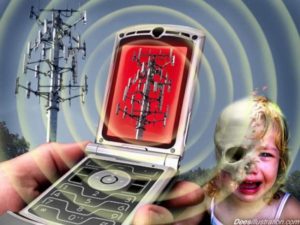
 Fifteen residents lined up following Blake’s introductory comments to speak on the issue themselves. An overwhelming theme of most who testified Nov. 2 said they were mostly concerned with possible negative health effects, and property values dropping should the tower become a reality. Most said they didn’t want the tower in their residential neighborhood.
 If petitions are any indication, a growing number of Canadians are very concerned about being zapped by radiation from their cellphones, baby monitors and wireless internet routers.